

Mooving Cows is an agricultural learning game developed with University of Wisconsin-Madison that focuses on best practices for cattle handling on dairy farms. Players take on the role of a cow mover to guide cattle through farm environments.
Explore →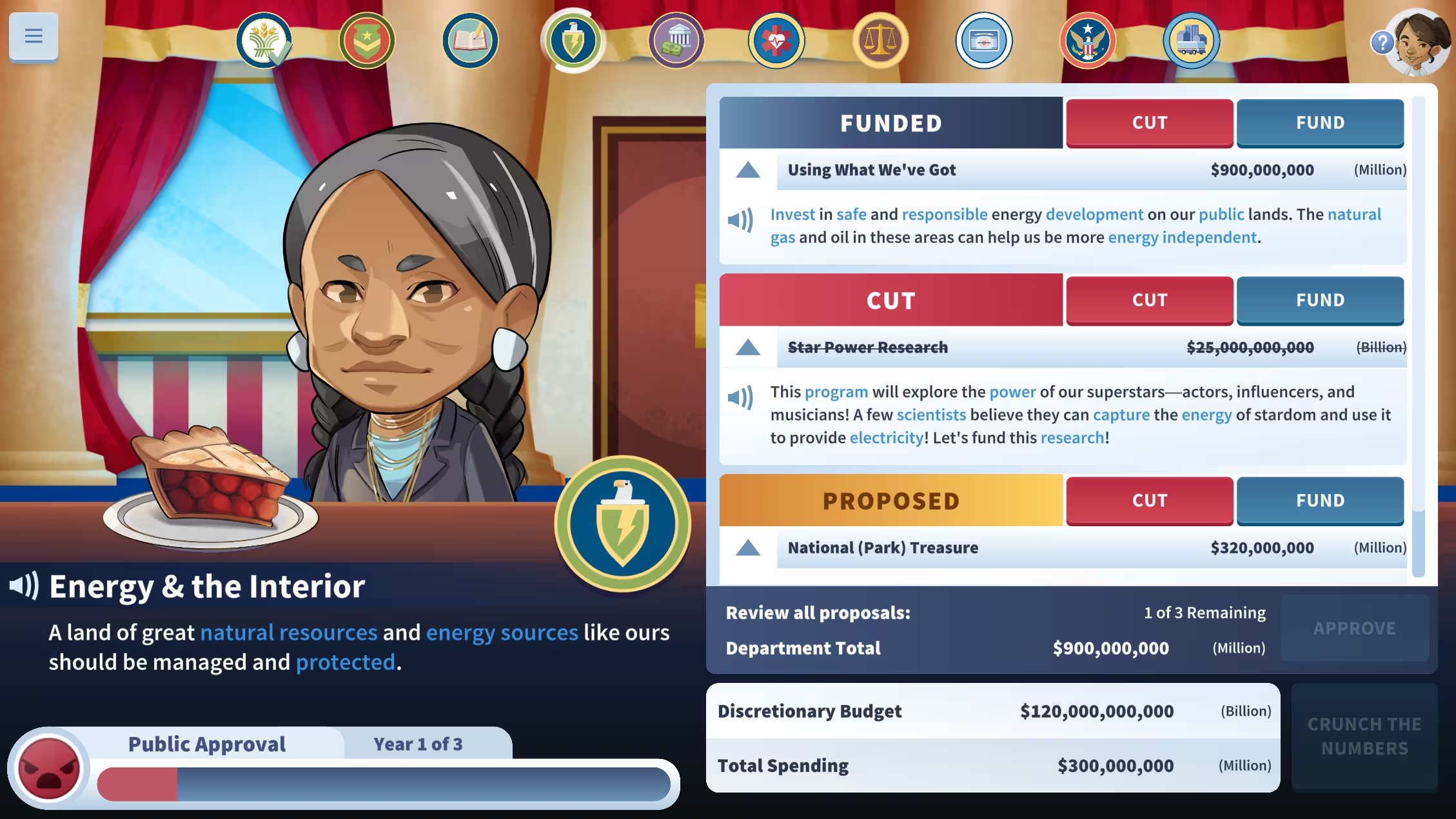
People’s Pie is a civics learning game developed with iCivics that focuses on the federal budgeting process. Players create and balance a national budget by making decisions about taxes, borrowing, and spending while responding to citizen satisfaction and economic conditions.
Explore →Organizations pour massive capital into workforce upskilling, yet many employers still struggle to provide training that sticks. There’s a good reason that human brains are also known as noodles - as it turns out, the spaghetti can be rather forgetty. Understandably, those who sit through dense instructional slide decks forget that information within a few weeks. We know that passive memorization simply fails to anchor complex operational reflexes. This is where games come in! When professionals learn through active experimentation and immediate feedback inside digital sandboxes, they build permanent behavioral habits. Educational game design turns abstract concepts into practical, sticky experiences that learners genuinely care about. Let's examine the latest empirical research to see exactly how custom game mechanics lock in verifiable, long-term knowledge retention across high-stakes enterprise verticals.
A 2026 study published in Education Sciences demonstrated how a 3D virtual escape room locked complex cybersecurity governance concepts into active memory. The researchers built a digital workplace where working learners solved sequential problems across three distinct zones to analyze risks, match security frameworks, and draft organizational policies. Trainees engaged in authentic, performance-based tasks to master the regulatory material interactively. Survey data confirmed that all participants found grasping critical course content easier through this interactive format compared to traditional methods. Scaffolding multi-step decisions inside a consequence-rich simulation successfully secures deep conceptual understanding.
An August 2025 empirical study in Applied Sciences evaluated how combining virtual reality with Al-driven conversational agents improves knowledge retention. The researchers tracked 120 professionals from 25 enterprises practicing high-pressure client negotiations against realistic, dynamically adaptive avatars. Trainees utilizing the VR platform achieved an exceptional 89% knowledge retention rate four weeks post-intervention. Control participants restricted to traditional classroom workshops didn't hold onto their skills as effectively, retaining just 72% of their acquired knowledge.
A May 2026 randomized controlled trial published in Higher Education, Skills and Work-based Learning measured how simulation training preserves critical decision-making abilities over extended periods. The researchers divided 70 nursing learners into traditional lecture and scenario-based simulation groups to practice clinical crisis management. Trainees in the simulation cohort scored drastically higher in early warning recognition and crisis response immediately following the exercise. These operational gains remained fully sustained during a three-month follow-up evaluation. Immersing individuals in high-fidelity practice spaces directly anchors vital knowledge, ensuring working professionals maintain their proficiency long after the initial session ends.
An August 2025 systematic review published in Interactive Learning Environments evaluated ten years of enterprise gamification and serious game deployments across corporate sectors. The comprehensive analysis confirms that aligning game mechanics directly with explicit learning objectives consistently improves long-term knowledge retention and intrinsic motivation. The researchers discovered that retention relies heavily on structured, logical game design. Trainees actively rejected the learning material when managers introduced forced competition or altered gameplay rules arbitrarily. A workforce doesn't tune out when custom learning environments offer transparent objectives, meaningful challenges, and reliable feedback loops.
~
Empirical data confirms that putting working professionals inside immersive, consequence-rich simulations successfully overcomes the forgetting curve and locks in verifiable, long-term operational knowledge. Designing custom educational games allows your enterprise to discard passive slide decks and secure permanent behavioral reflexes across your workforce. Interested in building custom scenario-driven learning games to maximize knowledge retention across your corporate training pipeline? Let's talk.
Best practices for preventing motion sickness while maximizing learning outcomes.
Best practices for preventing motion sickness while maximizing learning outcomes.
Get the latest Game-Based Learning Review content delivered to your inbox, including new articles, videos, and industry insights.