
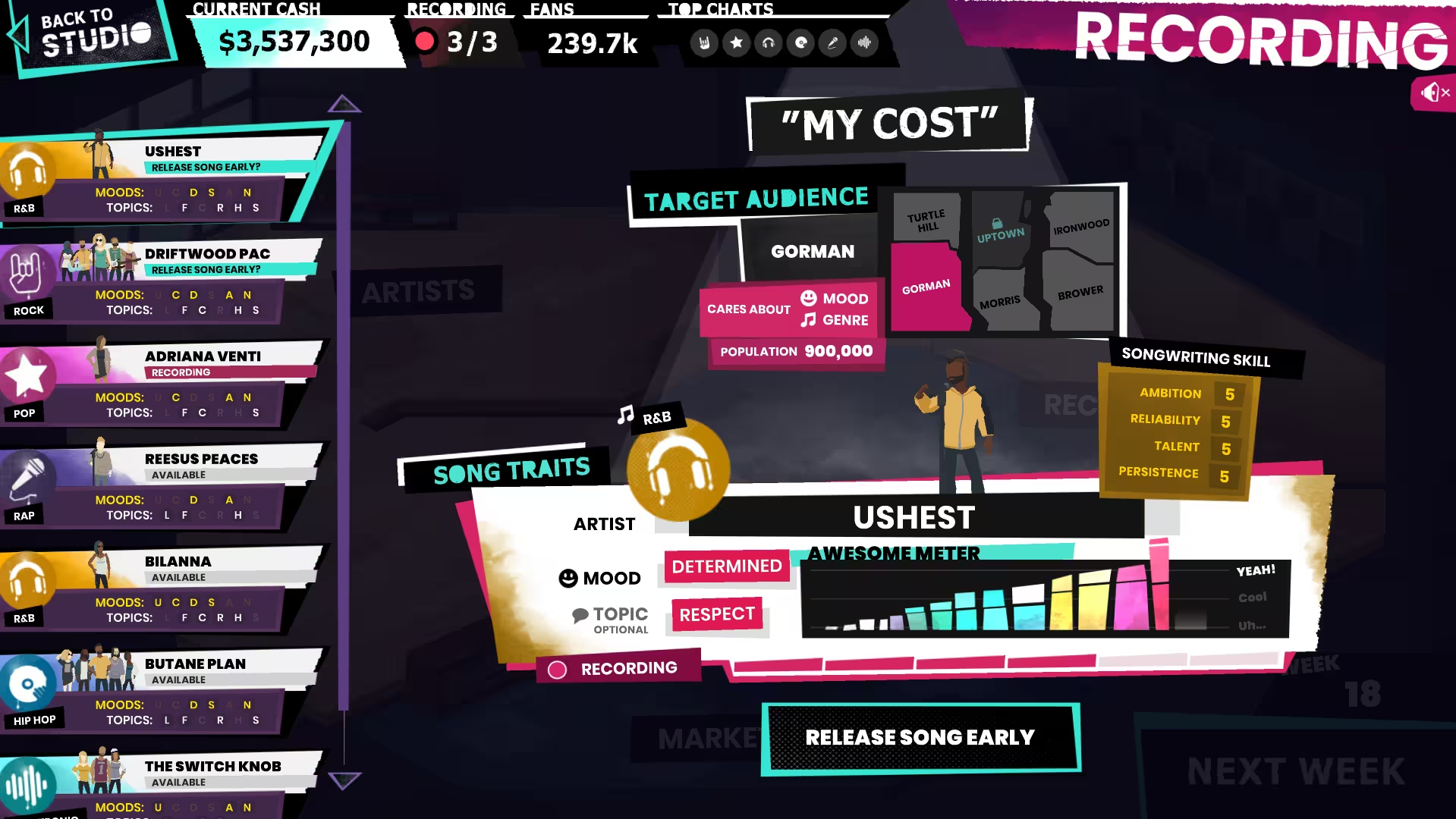
Beats Empire is a turn-based computational thinking and data analysis game developed for Columbia University and delivered through web browsers. Players run a music studio and record label, using market data from a fictional city to guide business decisions.
Explore →
Mindful Market™ is a therapeutic VR learning experience developed with Penumbra, Inc. focusing on executive function and resilience. Players complete structured daily tasks to rebuild working memory and cognitive skills.
Explore →Ask us what makes an educational game succeed and we'll happily talk your ear off about mechanics, feedback loops, and hours of playtesting. But in terms of how this content reaches a student, there’s a lot more to be considered, and much of it is rather technical. For a game to truly maximize its potential, it needs to be able to run inside the learning platforms that districts already live in. For the studios, publishers, and institutions we build for, that deployment story runs through a standard called Learning Tools Interoperability, or LTI. When it comes to game-based learning, LTI can be the difference between shipping and scaling.
Districts don't buy the way they used to. With the huge variety of implemented platforms on the market these days, adoption runs through IT departments weighing whether your product fits the systems they already support. CoSN's 2026 State of EdTech report, drawing on 607 K-12 leaders across 44 states, keeps cybersecurity at the top of their priority list (where it's sat since 2018), with data privacy close behind, and it flags district silos as a top-three headache in nine of the past thirteen years. What this means is that anything that plugs in through a standard IT already trusts sails through procurement, while a one-off integration becomes the line item that gets deferred to next year. The market makes the stakes concrete. ListEdTech's May 2026 data puts Google Classroom around 31% of K-12, Canvas near 24%, and Schoology third, with those three covering close to three-quarters of the country's classrooms.
Let’s take a closer look at the mechanic underneath it all. LTI lets a learning platform launch your game alongside important contextual learning information like who the student is, what role they hold, and which class they're in. A learner clicks a link in Canvas, and voila, your game opens already knowing it's third-period biology, with nobody required to set up a separate login. LTI 1.3 is the current version, built on the 1EdTech Security Framework (OAuth 2.0, JSON Web Tokens, OpenID Connect), and it retired the old shared-secret approach earlier versions leaned on. 1EdTech stopped supporting versions 1.0 through 2.0 back in June 2022, so 1.3 is now the only game in town. On top of that core, LTI Advantage adds three services worth knowing by name: Deep Linking lets a teacher drop a specific level or activity straight into a course, Names and Roles hands your game the class roster so it can tell the students from the teacher, and Assignment and Grade Services pipes scores back into the gradebook automatically, frequently the one feature that decides whether teachers keep a tool at all. When we built Discussion Maker, a multiplayer classroom game meant for teacher-led small groups, that roster question was a must-have. The whole experience depends on the game knowing exactly who's in the room, ideally with almost no friction for the educators or students.
Knowing the standard and shipping a clean integration are two different jobs, and a handful of details cause most of the pain. Key management that works for every platform means storing and rotating cryptographic keys, and teams that treat it as a one-time setup get an unpleasant surprise the first time a key rotates in production. Grade passback hides more edge cases than you'd expect, since partial credit, resubmissions, and repeat attempts all have to land correctly in a gradebook that was never designed with your game in mind. And we can’t forget Google Classroom, the single biggest platform in K-12, which doesn't support LTI at all. Classroom runs on its own APIs and Add-ons, so real K-12 reach usually takes two roads at once, LTI 1.3 for Canvas, Schoology, and Brightspace, plus a separate Classroom build for the platform with the most students of all. Plan for both early and you'll spare yourself the difficulty and expense of rebuilding your whole integration layer six months in.
~
When it comes to scaling and growing game audiences, we always bear in mind that a game changes something only when it reaches learners, and reaching learners means showing up inside the tools that schools and districts already trust. Two decades in, the Filament projects that succeed are the ones a teacher can pull up on a Monday morning without filing a support ticket. If you're building a game-based learning product and you want it to work seamlessly with the systems your audience already runs, let's talk.
Best practices for preventing motion sickness while maximizing learning outcomes.
Best practices for preventing motion sickness while maximizing learning outcomes.
Get the latest Game-Based Learning Review content delivered to your inbox, including new articles, videos, and industry insights.