


Mindful Market™ is a therapeutic VR learning experience developed with Penumbra, Inc. focusing on executive function and resilience. Players complete structured daily tasks to rebuild working memory and cognitive skills.
Explore →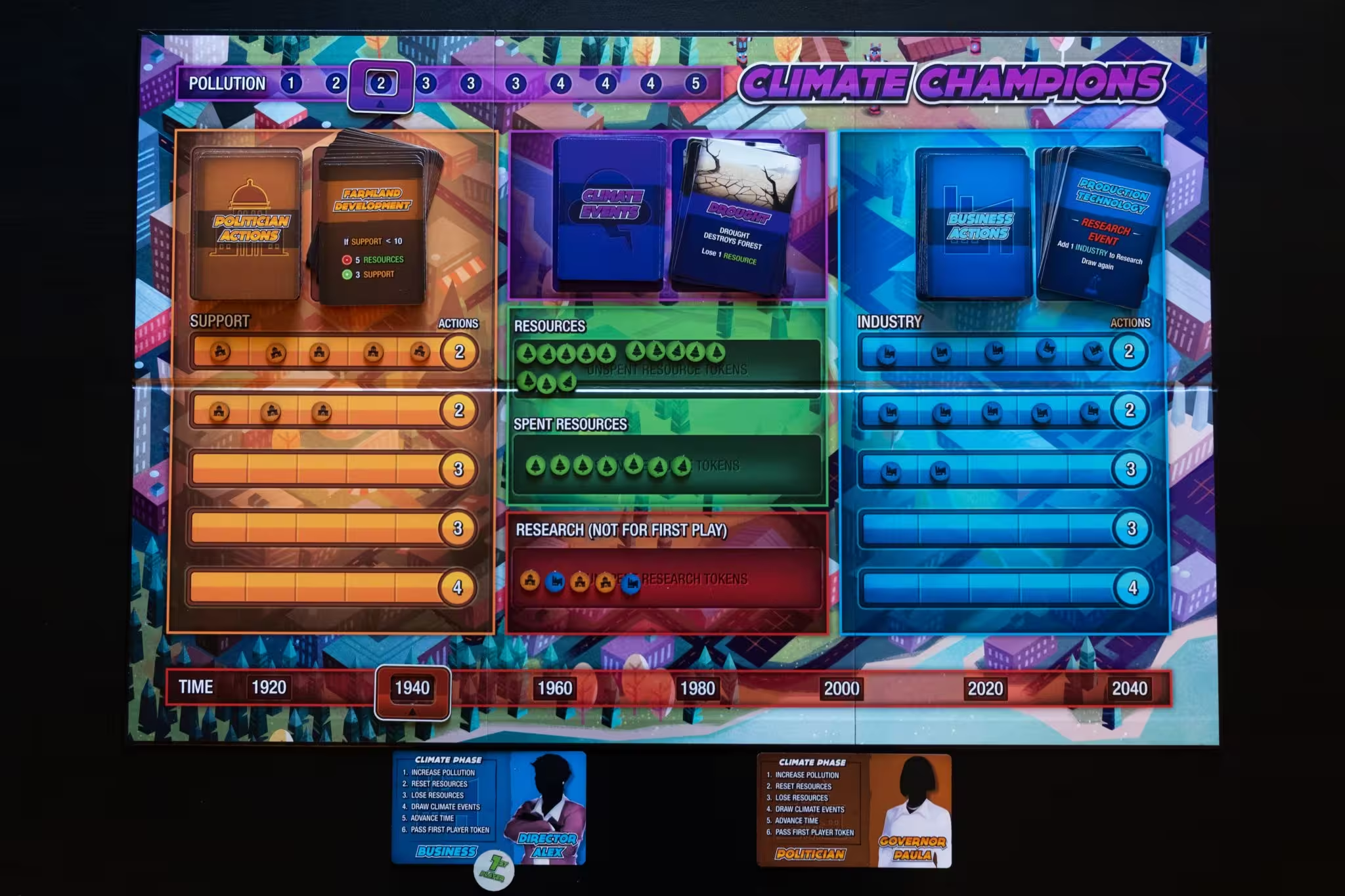
Climate Champions is a climate science learning board game developed with Educational Service District 101 that focuses on the environmental and economic impacts of climate change. Players collaborate to grow Washington State’s economy while managing resources.
Explore →High-stakes onboarding for medical and industrial workforces often demands zero-error performance right out of the gate, which can make traditional training methods feel pretty insufficient. You simply can't risk real-world disasters when training someone to handle a surgical crisis or operate heavy industrial equipment. Now, you might imagine where we’re going with this, being that we’re educational game developers. But it’s not just our bias speaking! As it turns out, immersive simulation environments solve these issues by moving high-risk procedural mastery into safe digital spaces. This week's research roundup explores how extended reality platforms provide the precise data tracking and sensory realism needed to verify complex professional skills. We'll look at empirical validation across medicine, mining, and complex task sequencing to see how immersive design translates directly into job readiness.
This editorial from Frontiers in Virtual Reality examines how immersive simulation platforms cultivate essential psychological and behavioral skills alongside standard technical task proficiency. The authors highlight that task and motor-control training often overshadow critical psychological competencies like emotion regulation, procedural confidence, and attentional control during high-demand scenarios. According to data cited in the compilation, a specific trial showed that nursing students achieved a heightened sense of presence and superior procedural comprehension via headset-based training. Immersive environments strengthen the integration of rules within dynamic contexts by providing first-person perspectives that 2D videos simply don't match. This sensory fidelity ensures that cognitive mental models transfer effectively to real-world application.
Another randomized controlled trial in JMIR Medical Education directly compared virtual reality training with high-fidelity physical simulations for novice physicians handling acute medical emergencies. This study tracked 164 medical interns and found that confidence scores in managing critical patient desaturation jumped significantly from a mean of 3.78 to 6.20 out of 10 across both training methods. Qualitative analysis revealed that interns specifically valued the virtual platform for its isolated environment, focused repetition, and lack of external distractions. These distinct advantages facilitated structured, stepwise problem-solving during high-pressure incidents. The researchers concluded that the inherent scalability of digital simulation provides vital accessibility for diverse professional development workflows and settings.
To improve safety at open-cast marble quarries in Italy, the research team behind this interactive safety program utilized specialized software to track real-time performance metrics like completion times, error rates, and user decisions across forty volunteers. Workers actively navigated high-risk scenarios, including machinery hazards and simulated wire breakages, within a controlled digital replica of the Alpine quarries. Post-training retention tracking proved that prior field experience drastically altered how users processed the simulation. Veteran quarry workers excelled at memorizing their virtual errors and structural mistakes. This typoe of proof is invaluable when designing targeted modules for various workforce demographics.
This methods paper outlines the systematic integration of a virtual anesthesia platform into an introductory clinical curriculum. Faculty members evaluated twenty-two participants using the System Usability Scale and recorded an impressive mean score of 76.6, which confirms good-to-excellent system usability. NASA Task Load Index metrics revealed low perceived physical and temporal workload, meaning the digital simulations didn't cause excessive cognitive strain. The authors noted that a phased rollout strategy successfully supports faculty preparation while aligning seamlessly with mandatory competency-based mastery goals, an important example of validating practical skills via clear digital portfolios.
Another publication in the International Journal of Environmental Research and Public Health introduces a comprehensive macro-level model designed to evaluate the entire life cycle of virtual reality safety training. This structural framework spans three core phases including upfront design compliance, real-time session delivery, and long-term socio-economic organizational evaluation. The researchers combined standard information technology metrics with established educational evaluation techniques to build standard criteria applicable across multiple industrial sectors. Their protocol tracks user psychophysical states, system usability variables, and post-simulation behavior changes over extended periods. Implementing this multi-tiered evaluation methodology ensures that corporate training investments yield measurable, verifiable improvements in overall workplace safety compliance metrics.
~
Verified empirical data proves that immersive simulation platforms provide a highly effective, safe, and measurable framework for mastering complex operational skills under intense pressure. Embedding these interactive tools into your onboarding pipeline allows your organization to secure concrete evidence of employee readiness while completely eliminating real-world training risks. Interested in building immersive, data-driven simulations for your talent development pipeline? Let's talk.
Best practices for preventing motion sickness while maximizing learning outcomes.
Best practices for preventing motion sickness while maximizing learning outcomes.
Get the latest Game-Based Learning Review content delivered to your inbox, including new articles, videos, and industry insights.