

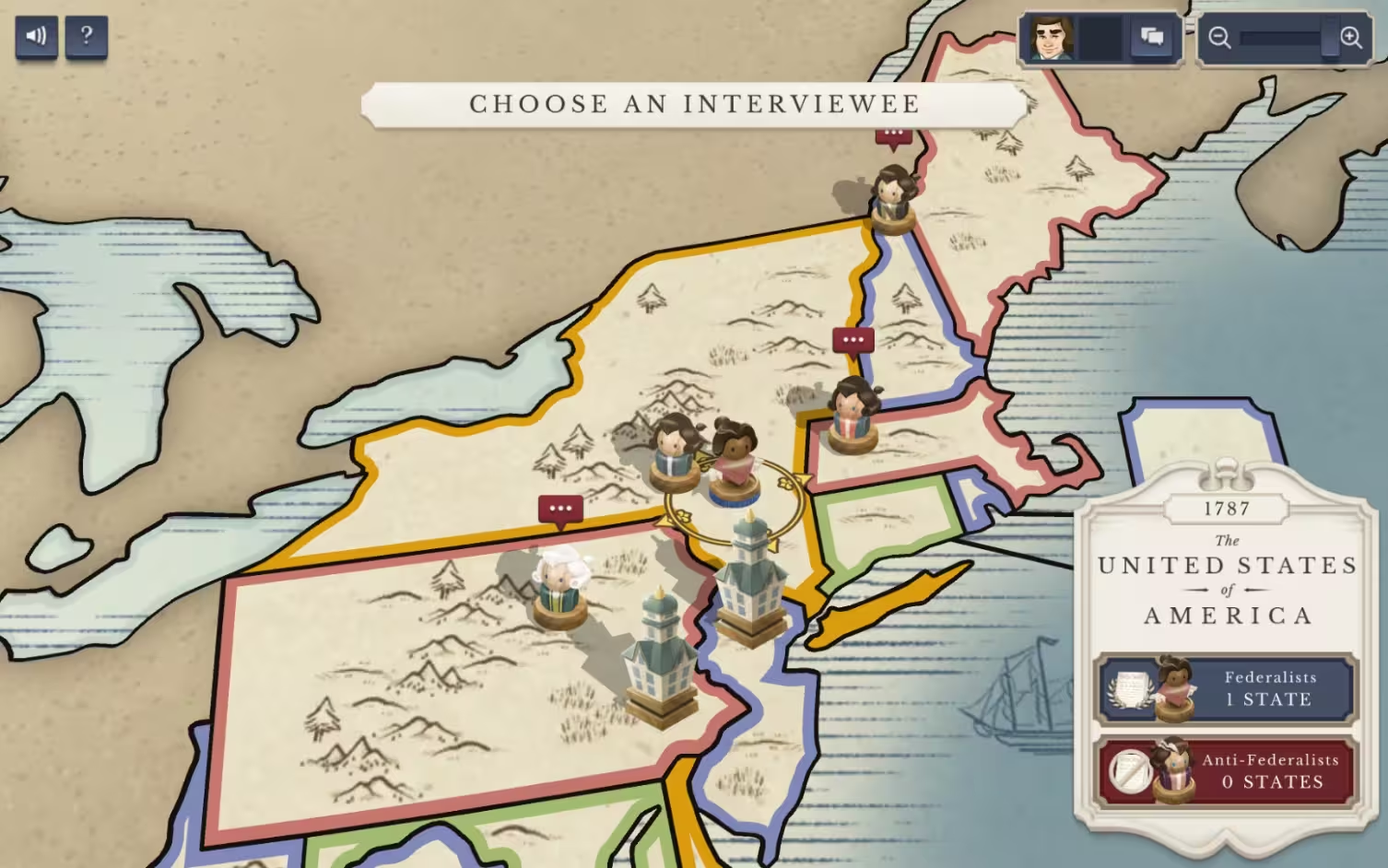
Race to Ratify is a civics learning game developed with iCivics that focuses on the debate over ratifying the U.S. Constitution. Players take on the role of a pamphleteer aligned with either the Federalists or Anti-Federalists, traveling across the thirteen states to gather arguments and influence public opinion.
Explore →
Toad Road is a physical science learning game developed with Twin Cities PBS that focuses on how material properties affect function. Players select and place bridges made from different materials to help characters cross obstacles.
Explore →Rapid changes in how we work and live are changing how we think about training. Employers and educators are actively seeking new ways to measure, develop, and verify specific capabilities that matter on the job. These days, degrees just don't tell the whole story about what a candidate can actually do. As the skills economy matures in 2026, interactive sandboxes and verified digital artifacts are taking center stage, which is great news for educational game developers like us. Game-based learning provides an ideal environment for learners to demonstrate complex problem-solving and collaboration under pressure. This week's roundup highlights recent research and industry insights examining the growth of microcredentials, the application of digital badges in classrooms, and the role of interactive experiences in modern professional development.
Endless Access and the ASU Endless Games and Learning Lab recently highlighted how game creation serves as a robust engine for skill verification. Their March 2026 report explains that building games requires learners to navigate ambiguous constraints, manage projects, and write code collaboratively. These competencies mirror the exact requirements of the modern workplace. The authors note that nearly 44% of workers require reskilling by 2030, which is exactly why major tech companies are dropping formal degree requirements. Through programs like StoryQuest, students design narrative assets and game mechanics, earning microcredentials backed by real, playable artifacts. These verifiable portfolios offer hiring managers concrete proof of contribution rather than abstract completion metrics.
Digital Promise published an analysis in May 2026 positioning micro-credentials as the fundamental currency of modern professional advancement. Their research shows that rapid technological advancement renders many roles obsolete, exposing the limitations of traditional postsecondary education. Micro-credentials solve this alignment issue by offering specific, competency-based indicators of what a learner can actually do. Candidates use these verifiable credentials to establish immediate trust with hiring managers. The report details how competency-based hiring prioritizes demonstrated skills over past job titles. For corporate training developers, it's a clear mandate to build short, targeted learning modules that deliver immediately applicable outcomes and precise data on employee performance.
A recent publication in the NACTA Journal details the Agriculture Workforce Training for Collaborative Leadership project, demonstrating how community colleges successfully integrate digital badging to measure readiness. The study emphasizes that agricultural employers prioritize communication, adaptability, and self-management alongside technical knowledge. Faculty members utilized digital badges to help students connect their classroom work and co-curricular experiences directly to employability skills. By embedding gamification and experiential learning frameworks into the curriculum, educators motivated students to reflect on their prior knowledge. The researchers found that formally documenting these soft skills gives students a tangible way to articulate their professional value, while providing institutions an assessment mechanism they can actually trust.
~
As employers increasingly value demonstrated abilities over formal degrees, verifiable microcredentials and interactive simulations provide the exact tools needed to track and validate learner progress. Building engaging, evidence-based digital experiences ensures your training programs deliver measurable outcomes for the modern workforce. Interested in developing impactful, skills-aligned educational games for your learners? Let's talk.
Best practices for preventing motion sickness while maximizing learning outcomes.
Best practices for preventing motion sickness while maximizing learning outcomes.
Get the latest Game-Based Learning Review content delivered to your inbox, including new articles, videos, and industry insights.