


Executive Command is a civics learning game developed with iCivics that focuses on the roles and responsibilities of the U.S. presidency. Players take on the role of the president, balancing legislative priorities and executive duties while managing competing national demands.
Explore →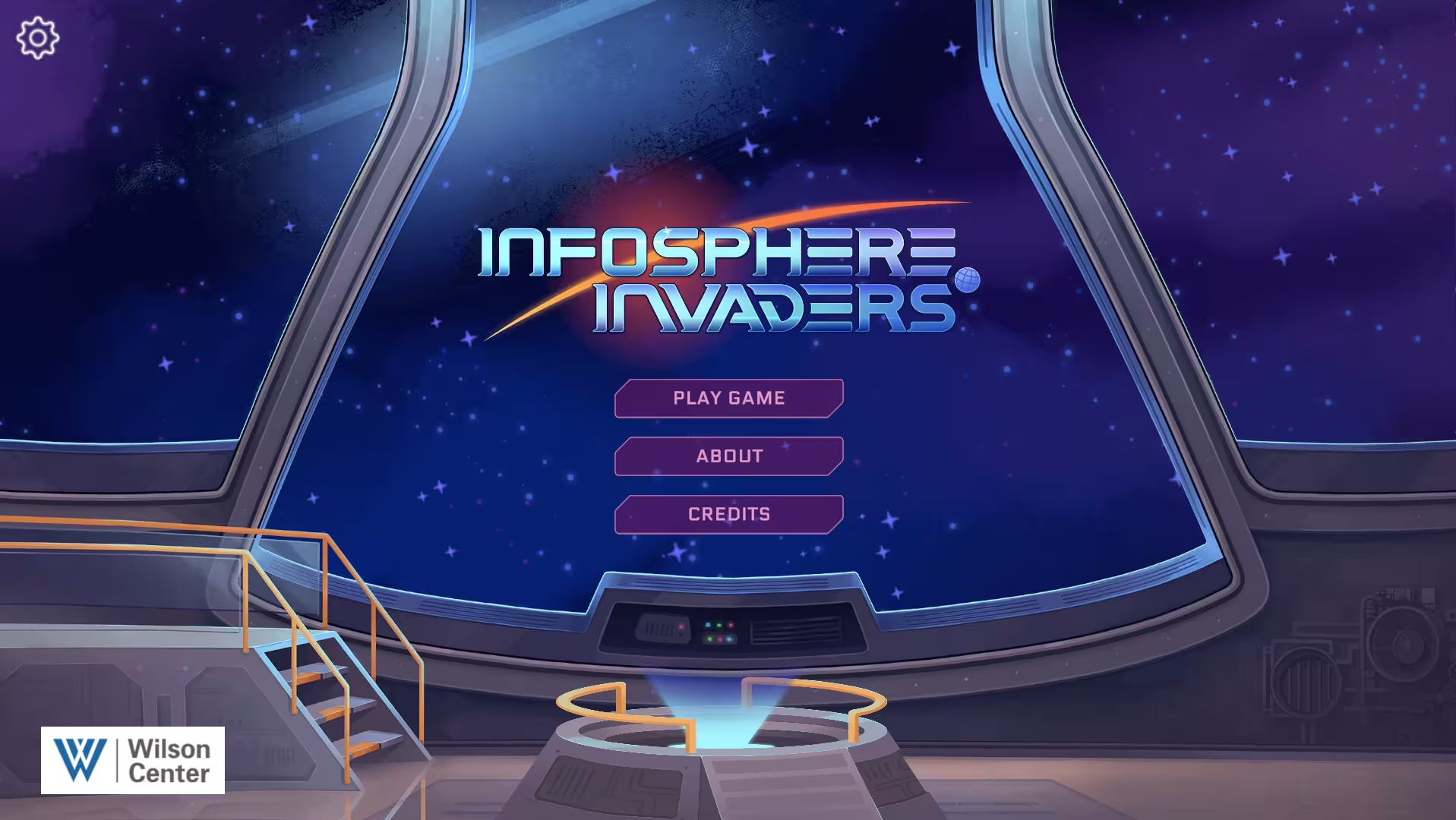
Infosphere Invaders is a media literacy learning game developed with Wilson Center that focuses on identifying and responding to disinformation. Players lead a team aboard a spaceship and complete missions that require evaluating information and recognizing misleading content.
Explore →10 years ago – yonks ago – in an article called Yes, You Are a Gamer, I noted that everyday existence is governed by mechanics and dynamics, meaning we all intuitively understand how to navigate complex, interactive rulesets. This is still true, and it’s getting truer. In a world suffused with complex systems, we need educational games and simulations that prepare us for the same! By designing educational games as intricate webs of interconnected variables, we encourage learners to grapple with cause, effect, and cascading consequences. With all that in mind, let’s explore how systems thinking is built into high-quality educational games.
Complex real-world issues require environments where learners can safely experiment with varied solutions. Educational games provide exactly this type of low-stakes setting for high-stakes problem-solving. Recent research at the University of Nebraska-Lincoln showed that when students interact with a simulated agroecosystem or supply chain, they develop robust mental models to navigate the simulation successfully. They learn to identify the invisible forces acting upon a given scenario. This act of playful experimentation bridges the gap between novice observation and expert analysis.
In their deep dive on systems thinking, Edutopia noted that a linear mindset assumes a single cause leads directly to a single effect. Systems thinking shatters that illusion by introducing the reality of nonlinear relationships and interconnected networks. Well-designed simulations require players to toggle constantly between the granular details of a specific task and the overarching goals of the entire system. Recognizing these broad patterns enables players to manage complexity without becoming overwhelmed. They begin to see how an adjustment in one department cascades through the entire organizational structure.
This study published by Springer explores the concept of learning a system system by building one or deconstructing it entirely. Game-based learning environments demand active participation in system analysis. Whether learners are analyzing resource flows or mapping decision trees, they are actively practicing the systemic design skills required in modern professional environments. Consistent exposure to these mechanics leads to measurable improvements in problem-solving capabilities across disparate contexts. This fosters better thinking skills by requiring them to play within the rules of a functional system.
–
As these sources illustrate, true mastery of a complex system requires active participation in its mechanics. Learners must manipulate variables and witness the resulting, cascading consequences firsthand. Game-based learning provides a rigorous, interactive sandbox for exactly this type of cognitive conditioning. By encouraging users to navigate nonlinear relationships and deconstruct functional rulesets, we build resilient problem-solvers prepared for the unpredictability of the modern workforce. If you’re ready to engineer a training environment that leverages the power of systems thinking, let’s talk!
Best practices for preventing motion sickness while maximizing learning outcomes.
Best practices for preventing motion sickness while maximizing learning outcomes.
Get the latest Game-Based Learning Review content delivered to your inbox, including new articles, videos, and industry insights.