

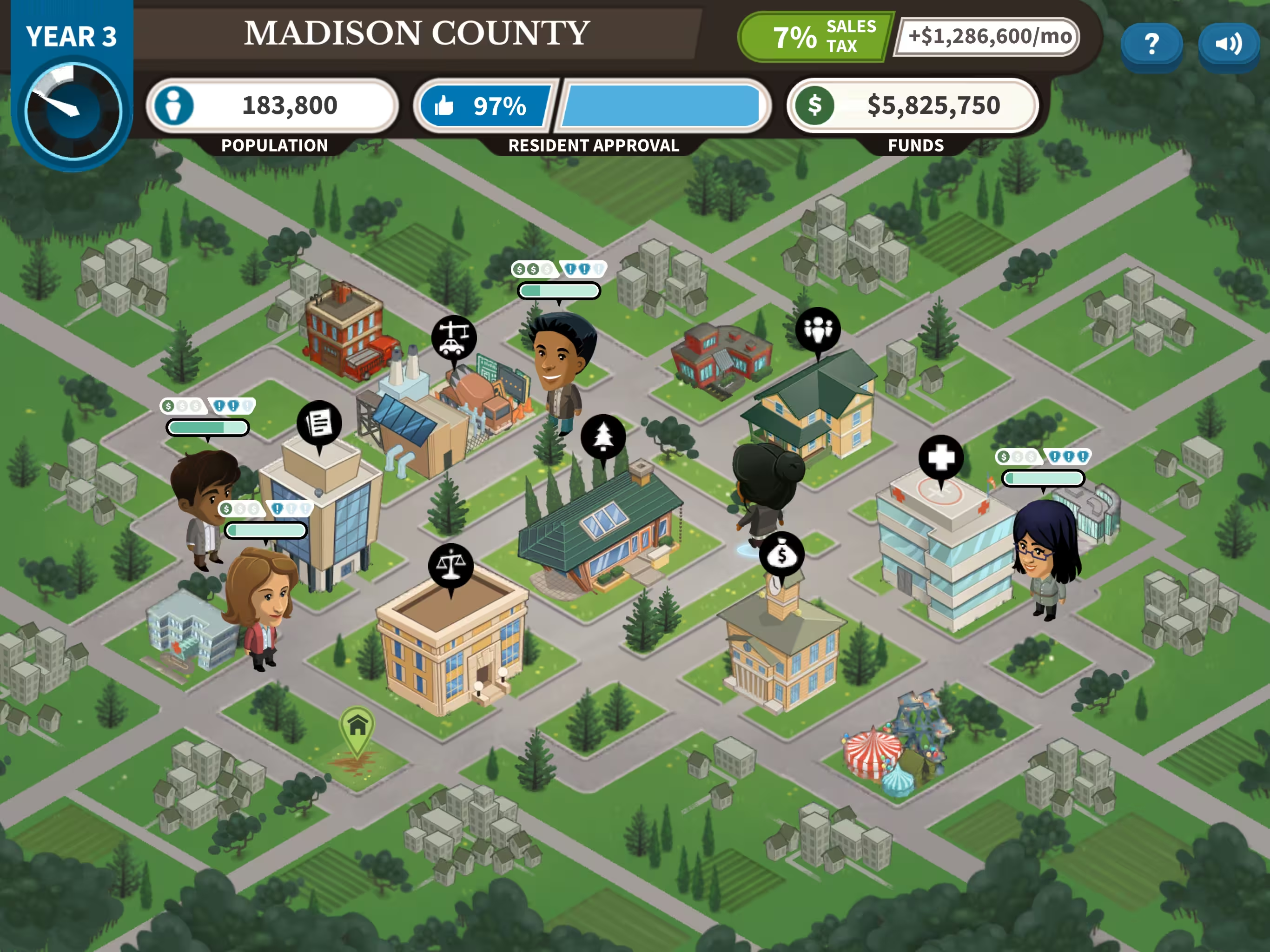
Counties Work: Texas is a civics learning game developed with iCivics that focuses on the structure and responsibilities of county government in Texas. Players take on the role of a county official, responding to resident requests, coordinating across departments, and managing budgets and taxes to keep county operations running effectively.
Explore →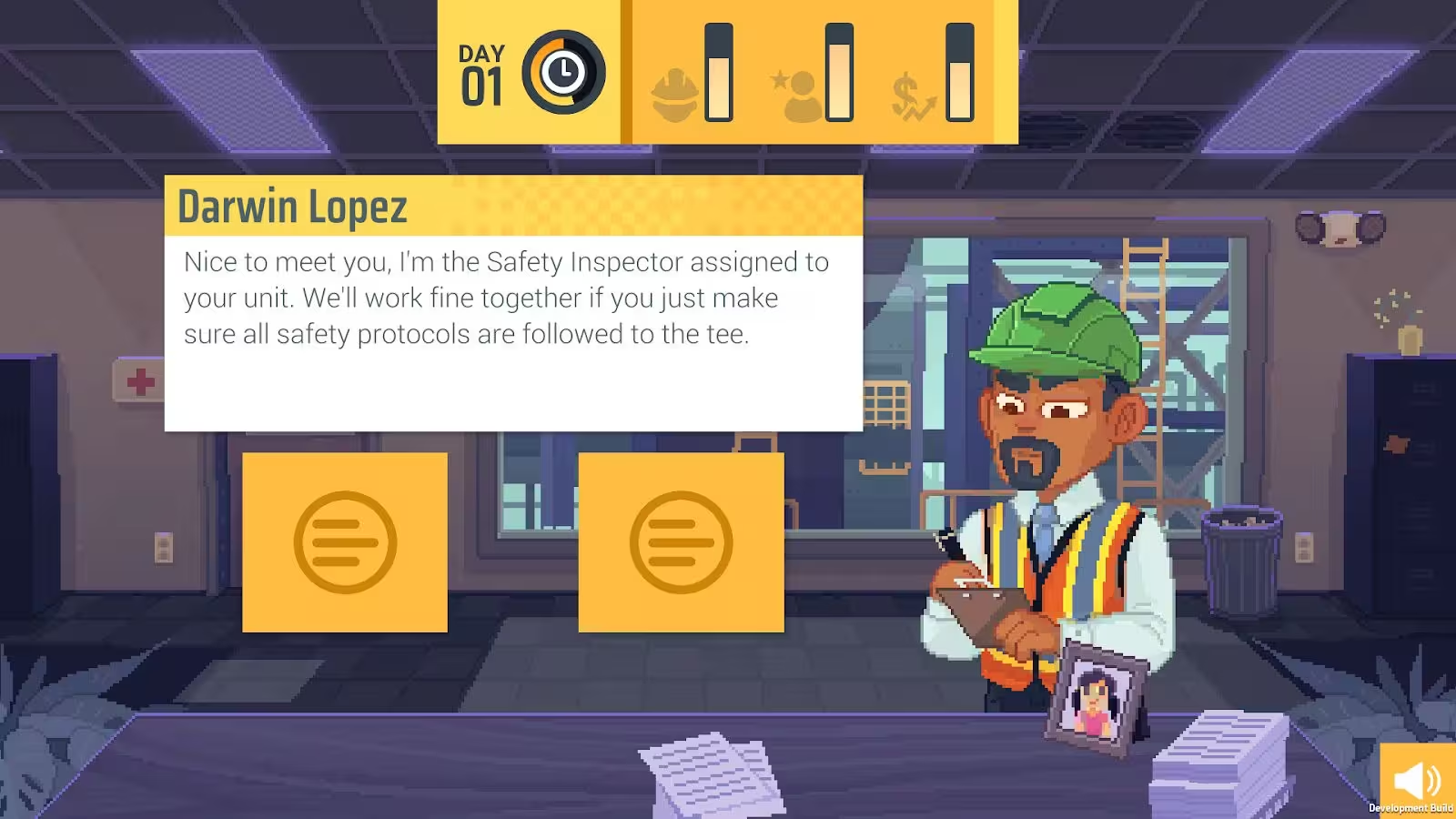
Contents Under Pressure is a safety and risk management game developed with Rowan University focusing on chemical plant operations. Players act as senior engineers, balancing production quotas with safety and reputation in high-stakes scenarios.
Explore →Enterprise learning design has reached an exciting level of sophistication, with the conversation around workplace gamification moving well beyond basic points, badges, and leaderboards. Modern enterprise operations require high-fidelity practice environments that reflect the genuine pressure of daily decision-making. Distributed teams and frontline managers benefit immensely from safe digital spaces where they can test complex hypotheses, experience realistic consequences, and build reliable instincts before facing a live crisis. Recent data demonstrates that scenario-driven game mechanics directly accelerate time-to-proficiency across high-stakes job functions. Let's examine how the latest research and enterprise case studies highlight the measurable operational value of immersive, consequence-rich simulation design.
This recent report published by Training Industry explores how artificial intelligence makes scenario-based simulation practice accessible to organizations of all sizes. Enterprise leaders historically avoided custom simulations due to prohibitive costs and lengthy development cycles. But data cited in the piece shows that 21% of employees feel their training just doesn't apply to their daily work. Dynamic simulation platforms resolve this friction by generating role-specific practice in real time. One highlighted enterprise achieved a 21% increase in skill performance and a 97% reduction in simulated errors using these adaptive tools.
Operational modeling delivers an exceptional layer of certainty for complex enterprise strategies. A detailed analysis from McKinsey & Company breaks down how digital-twin technology builds virtual replicas of physical systems to test live scenarios safely. Enterprise investment in these digital environments is growing rapidly, with the global market projected to hit seventy-three billion dollars by 2027. Product engineering teams rely on these virtual models to cut development timelines by fifty percent, and supply chain leaders deploy them to increase decision-making speeds by up to 90%. Linking these data-dense frameworks directly into custom learning games ensures your workforce doesn't risk real operational capital when practicing high-stakes decisions.
Instructional mechanics dictate whether a corporate learner stays genuinely invested or tunes out entirely. A 2025 action case study published in the International Journal of Organization Theory and Behavior observed how branching scenarios impact working professionals over time. The researchers discovered that learner motivation peaked when digital simulations mirrored authentic, day-to-day job tasks. Employees stayed highly engaged when exploring consequence-driven decision trees that offered safe failure and immediate contextual feedback. Conversely, participant engagement dropped the moment scenarios became repetitive, overly simplistic, or cognitively overwhelming. Custom game developers must scaffold challenge levels meticulously to ensure deep experiential learning doesn't trigger unnecessary mental fatigue.
Theoretical knowledge rarely survives the pressure of a real operational crisis. Thankfully, a 2026 industry report from Virti demonstrates that scenario-based training boosts knowledge retention by up to 35% over traditional methods, with experiential models reaching 90% retention. The analysis details practical deployments across complex enterprise sectors - for instance, with sales teams, simulated pushback ensures reps aren't testing their objection handling on live clients. In management training, interactive dilemmas force leaders to navigate ambiguity under extreme pressure. High-risk industrial sectors rely on these exact environments to practice safety protocols before physical accidents happen. Embedding realistic friction into your training modules builds permanent behavioral reflexes.
~
Bespoke, scenario-driven learning games allow your enterprise to move beyond passive theory and secure verifiable operational competency. By placing working professionals inside consequence-rich digital environments, you provide the exact behavioral sandbox necessary to turn hesitant employees into decisive, high-performing operators. Interested in exploring custom scenario game development to de-risk your enterprise training pipeline? Let's talk.
Best practices for preventing motion sickness while maximizing learning outcomes.
Best practices for preventing motion sickness while maximizing learning outcomes.
Get the latest Game-Based Learning Review content delivered to your inbox, including new articles, videos, and industry insights.