
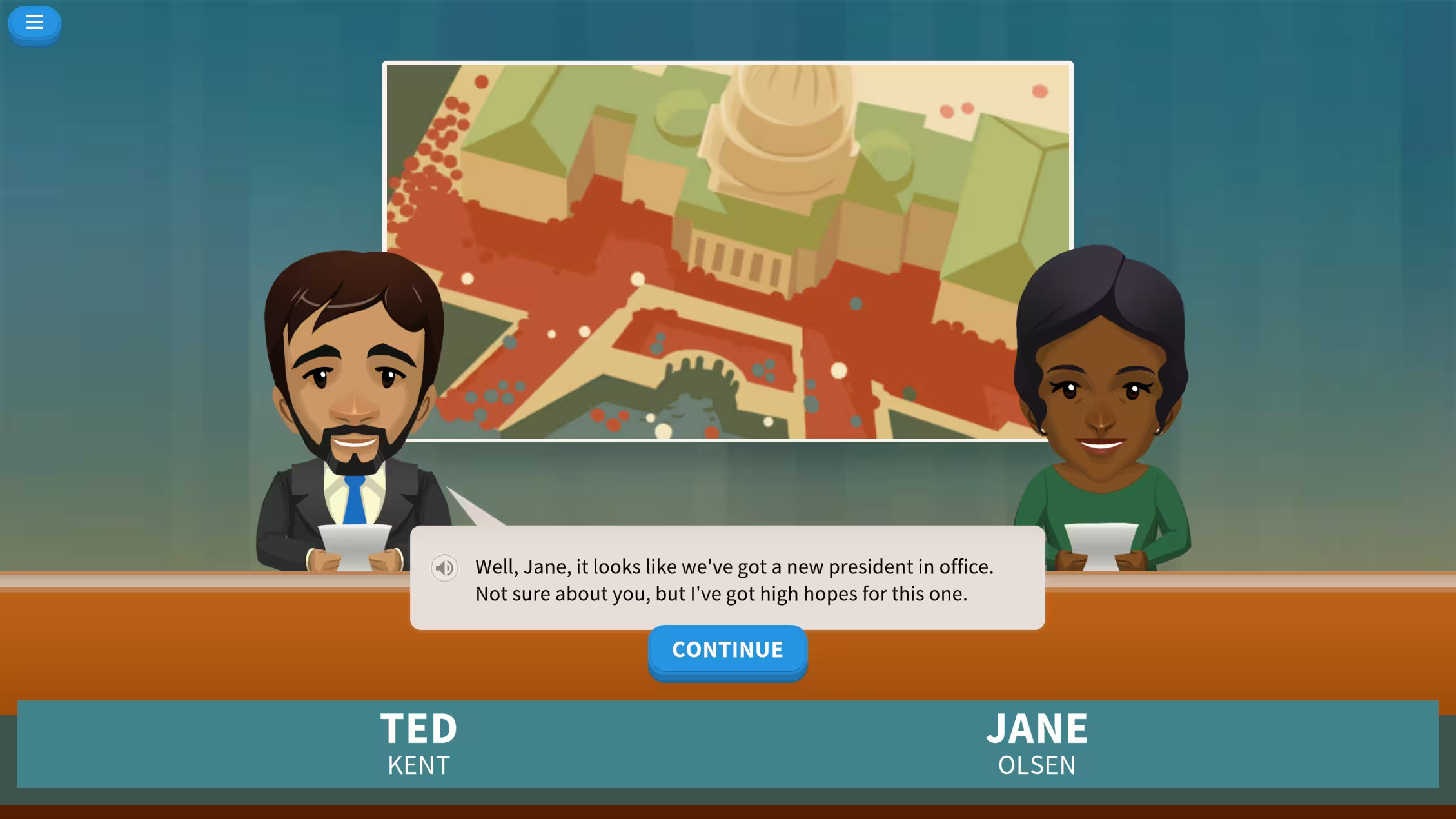
Executive Command is a civics learning game developed with iCivics that focuses on the roles and responsibilities of the U.S. presidency. Players take on the role of the president, balancing legislative priorities and executive duties while managing competing national demands.
Explore →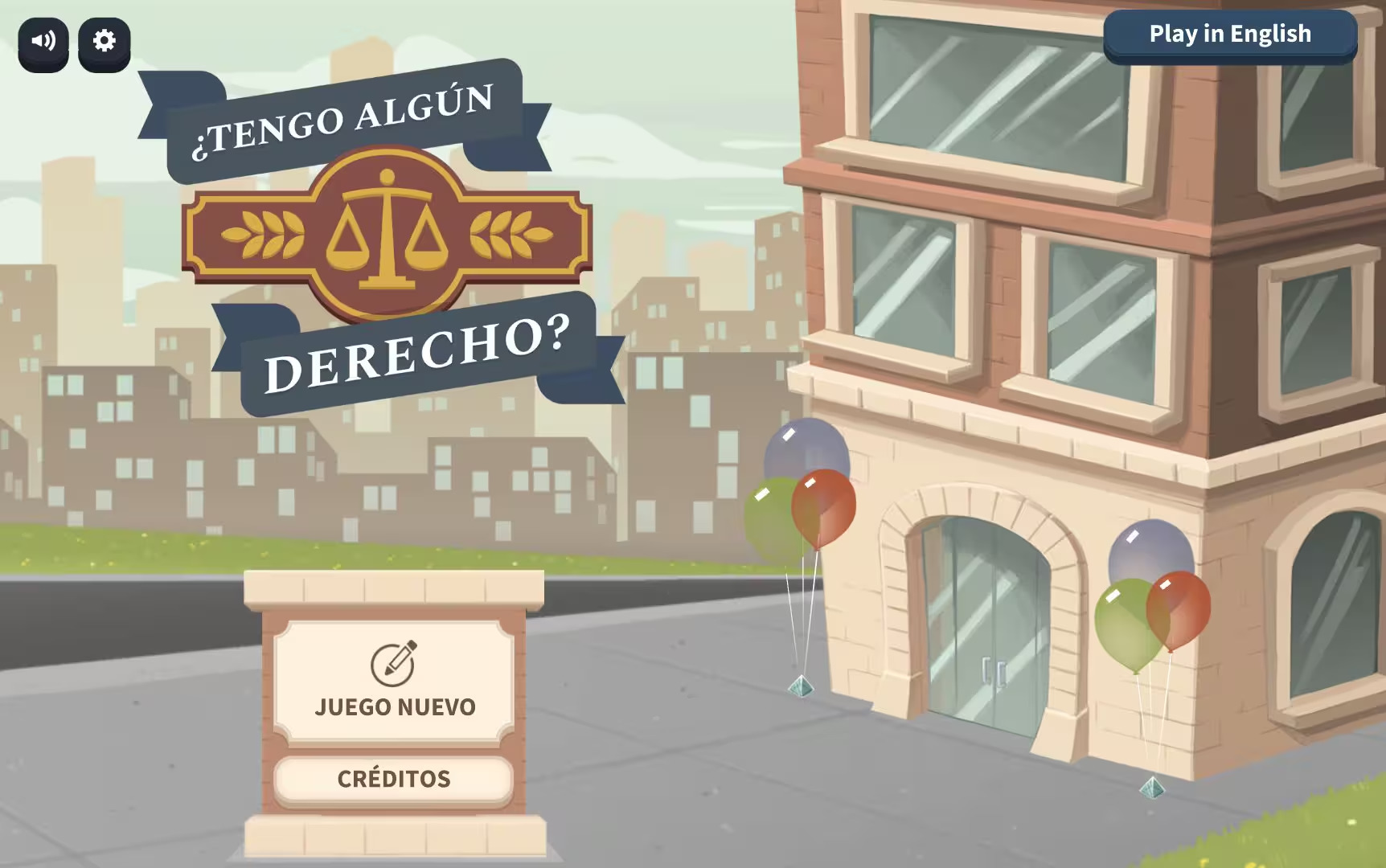
Do I Have a Right? is a civics learning game developed with iCivics that teaches constitutional law through interactive legal scenarios. Players run a law firm, determine whether clients’ rights have been violated, and argue cases based on the Bill of Rights.
Explore →Ask a game designer what a game is about and you'll often hear a list of verbs like jump or build or trade. Those verbs are the game's mechanics, and in a serious game they determine what a player practices on a minute-by-minute basis. Story, art, and dialogue give the learner context, and the mechanics are the actions which allow the learner to exercise the skill itself. That's why we treat translating each learning objective into verbs as one of the earliest and most consequential decisions in any Filament project. This week we're looking at four sources, spanning foundational game studies and recent learning science, that explain what game mechanics are in the context of a serious game, why they matter so much for learning, and how you can map them to the outcomes your project needs.
Researchers and designers have defined game mechanics in many different ways over the years, which makes precise conversations about design harder to pinpoint. Miguel Sicart of the IT University of Copenhagen addressed the problem in Game Studies by defining game mechanics as the methods agents invoke to interact with a game world. He applied the definition in a comparative analysis of Rez, Every Extend Extra, and Shadow of the Colossus, distinguishing mechanics from the rules and challenges that surround them. Because learning objectives also describe actions, an objective that asks learners to classify, predict, or negotiate already gives your team a starting list of candidate mechanics.
Educational software has often used gameplay as a reward wrapped around learning content, which keeps the play and the learning in separate compartments. Jacob Habgood and Shaaron Ainsworth tested an alternative they call intrinsic integration in the Journal of the Learning Sciences, building a math game called Zombie Division for children ages 7-11. In the intrinsic version, players defeat enemies by choosing sword attacks that divide the number shown on each zombie's chest, while the extrinsic version presents division separately as quiz questions. Children learned more from the intrinsic version under fixed time limits, and when given free choice they spent seven times longer playing it.
The evidence for intrinsic integration has been strong for more than a decade. Joe Cutting and Ioanna Iacovides ran a pre-registered study with 210 participants, published in Proceedings of the ACM on Human-Computer Interaction (CHI PLAY), using an educational game similar to Pac-Man to test whether motivation, cognitive load, or attention drives the effect. Learning was higher in the intrinsically integrated version, and neither motivation nor cognitive load showed significant effects. The researchers concluded that integration works through attention, since players focus on the features they need for the game task and set aside everything else. For your project, any information players must learn should sit inside the decisions your core mechanic asks them to make.
The behavior of a complex system emerges over time, which makes systems thinking difficult to convey through explanation alone. Thomas-Julian Irabor and colleagues at the University of Liège studied Tipping Point, a board game played on a shared island, with 70 participants across three academic programs in Belgium, and reported their findings in Humanities and Social Sciences Communications. Each turn, players must build a house, renovate one, or remove waste using randomly drawn resource tokens, while waste from every house steadily covers the board and the shrinking forest absorbs less of it. If the island fills before the sixth round, every player loses together, and across three sessions with debriefs, participants shifted from chasing individual points to pooling resources and planning for collective survival. Mechanics that tie each player's choices to a shared system let learners discover the lesson through play, a pattern well suited to any outcome involving tradeoffs or cooperation.
~
Each of these sources points your team toward the same opening question: what will the player do, and does that action require the skill you want to build? A clear definition of game mechanics keeps that conversation precise, the research on intrinsic integration and attention explains why the answer shapes learning outcomes, and mapping tools like LM-GM help you verify the answer before production begins. Well-chosen mechanics can also double as your assessment, a topic we covered in How Educational Game Designers Test Players Without Breaking Immersion. Choosing the core verb is the starting line for every serious game we build, and it's the decision with the greatest influence on whether a game teaches. Ready to find the right mechanics for your next learning game? Let's talk.
Best practices for preventing motion sickness while maximizing learning outcomes.
Best practices for preventing motion sickness while maximizing learning outcomes.
Get the latest Game-Based Learning Review content delivered to your inbox, including new articles, videos, and industry insights.