

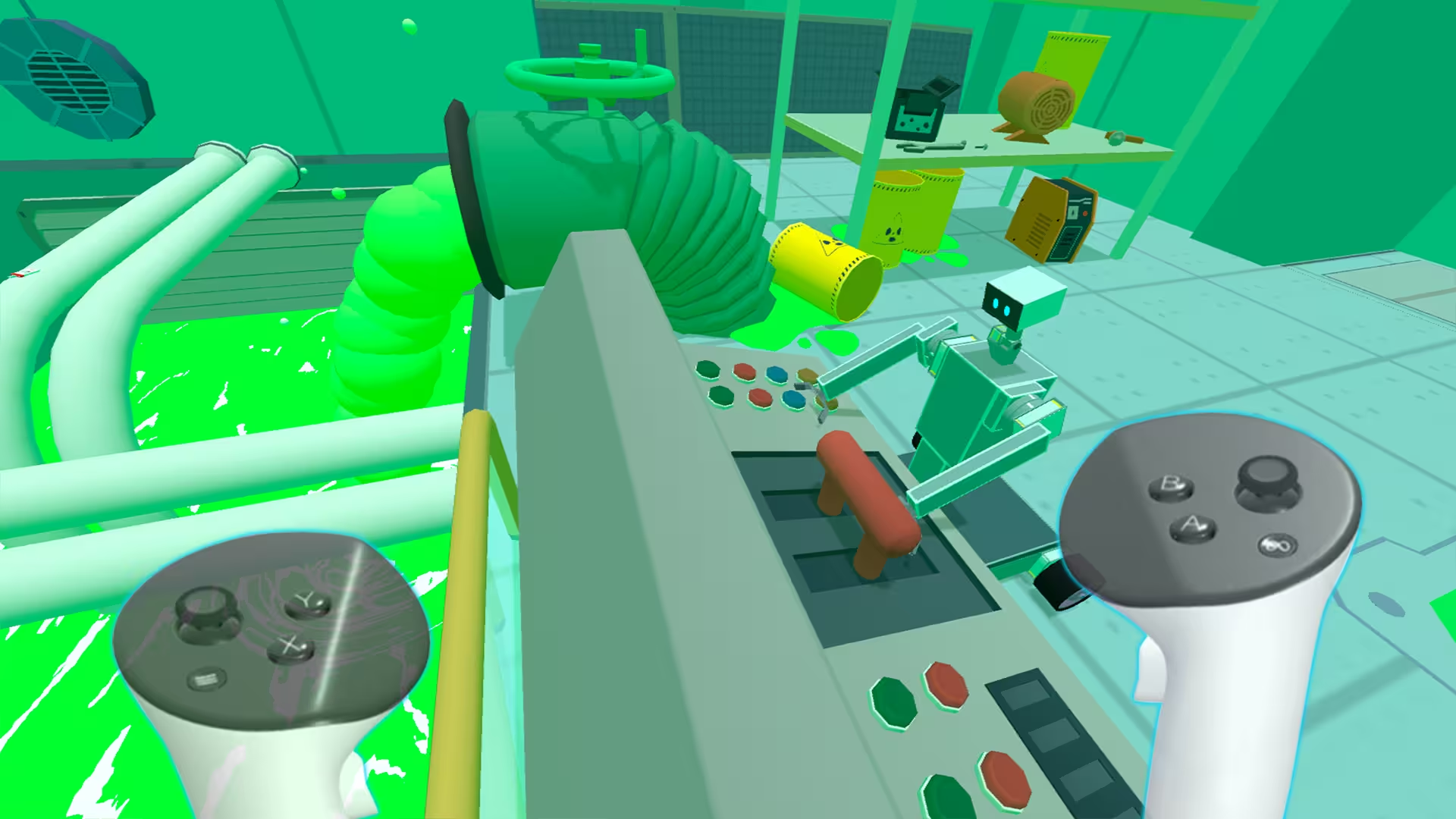
Some Assembly Required is a VR robotics sandbox game developed by Filament Games for Meta Quest 2 and 3. Players design and build robots with intuitive hands-on controls to complete mechanical challenges and explore a secret-filled warehouse.
Explore →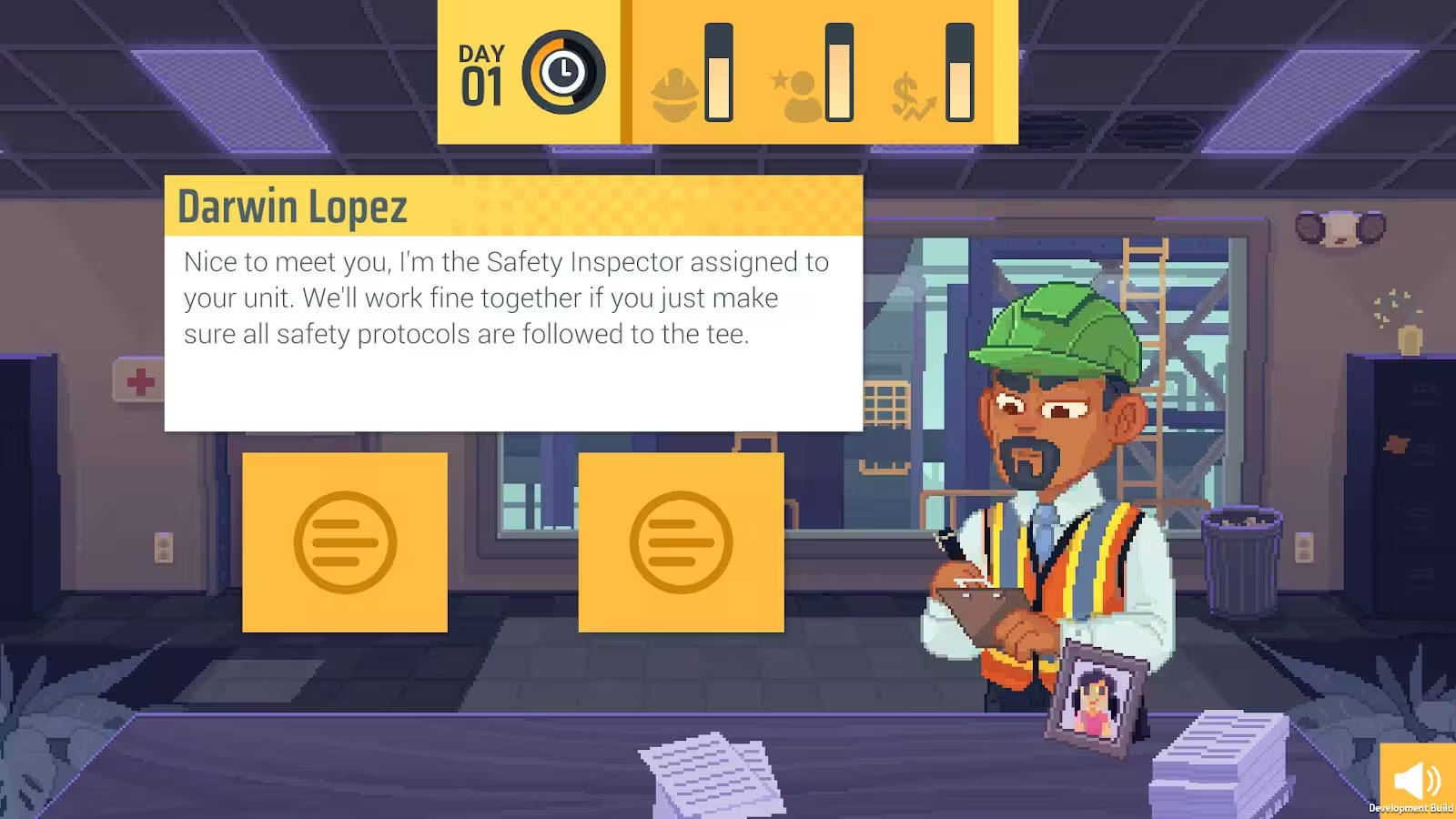
Contents Under Pressure is a safety and risk management game developed with Rowan University focusing on chemical plant operations. Players act as senior engineers, balancing production quotas with safety and reputation in high-stakes scenarios.
Explore →Welcome back to our monthly review of both the latest and the greatest game-based learning news. As usual, the past month provided a fascinating cross-section of example uses for educational games, and the thread running through most of them this time around is localization. Developers and educators are building experiences for specific communities and monitoring whether those experiences move the needle, from tropical disease prevention in Nigeria to renewable energy awareness in South Africa. Other stories this month look at the cognitive benefits of speed-training games for older adults, grassroots AI adoption by teachers in India, outdoor environmental education in Hawaii. We even cover one very thorough historical archive of retro gaming collections - we love when games are about learning, but sometimes? The learning is about the games. Anyhow. Let's get into it.
A recent NPR report profiles Schisto & Ladders, a tabletop game developed by a team at Akwa Ibom State University. Educators in Nigeria use this modified take on the classic board game to teach children about schistosomiasis prevention. Players navigate a board where positive actions let them climb ladders, while negative actions, like playing in contaminated river water, send their tokens sliding down parasitic worms. A six-month study published in International Health, involving 275 students, found that playing the game significantly increased awareness of the disease and of praziquantel, the drug used to prevent and treat it. By the end of the trial, 65% of participating students had signed up, with parental permission, to receive preventive treatment. It's a clear example of culturally relevant, localized game mechanics supporting crucial public health education.
Members of the Universal Teachers Academy in Tamil Nadu are generating their own interactive classroom materials using large language models. The Times of India details how these educators prompt AI tools to write HTML code for simple educational games aimed at primary school students. The games run on mobile phones without an internet connection or on classroom smartboards, enabling teachers with no coding experience to create picture-matching exercises and vowel-identification challenges. The academy is hosting a free online workshop for more than 1,200 educators, teaching them how to write the base prompts that generate these files. It's a compelling example of teachers building their own classroom tools with technology that's finally within reach.
Video game historian Andrew Elmore recently published a two-hour video essay chronicling every Namco Museum release from the last three decades. Aftermath covered the three-year project, detailing Elmore's process of researching, importing, and interviewing subjects to catalog these classic compilations. The final presentation breaks down each game across the various Namco collections and preserves gameplay footage and animation details from obscure 1980s arcade titles. Elmore also composed an original soundtrack for the piece, available on Bandcamp. This kind of preservation gives future developers and enthusiasts alike a reference library for the choices that shaped early arcade gaming.
A longitudinal study published in Alzheimer's & Dementia: Translational Research & Clinical Interventions tracked nearly 3,000 older adults over twenty years to measure the effects of cognitive exercise. As Women's Health reports, participants who played a specific speed-training video game and completed follow-up booster sessions showed a 25% lower risk of developing dementia than those who received no cognitive training. Participants who skipped the booster sessions saw no such benefit, and neither did the groups assigned to memory or reasoning training. The game asked players to locate objects on screen quickly and make split-second decisions. The researchers suggest that improving processing speed may be especially protective against subcortical types of dementia. It's an encouraging result, though the study's authors and outside experts are clear that more research is needed before anyone treats a game as dementia prevention. Try it out yourself!
Researchers in South Africa are developing a localized STEM game prototype called Renewable Rangers to teach young children about sustainable infrastructure. Writing in The Conversation, early childhood STEM researcher Moleboheng Mokhele explains that the game uses storytelling and visual learning to show how electricity is generated and why power outages happen. The characters travel across South African provinces, exploring regional renewable resources like solar and wind power along the way. The design builds in indigenous languages and cultural contexts so the story resonates with local learners. Targeting a gap in early childhood science education (which in South Africa is often held off until Grade 4), this project serves as a compelling demonstration of how place-based design makes complex science approachable for very young learners.
Here’s a slice of local EDU game news - twenty educators recently gathered at the Mānoa Heritage Center for a gameful professional development workshop focused on environmental science instruction. Honolulu Civil Beat covered the event, where teachers learned to fold analog games into their curriculum. Participants played Kumulāʻau, a resource-management card game that has players collect elements like water and soil to grow native Hawaiian trees such as ʻulu and kukui, while avoiding setbacks like wildfires. The session also included a localized version of Hanafuda built around native and invasive species. Local nonprofits including Trees for Honolulu's Future and Mālama Mānoa supported the workshop and its materials, and attendees received a $100 stipend courtesy of the Mānoa Heritage Center. There's clearly strong demand for interactive, well-designed experiences that reinforce vocabulary and regional ecological awareness.
~
This month’s examples demonstrate a variety of game-based learning use cases, but what they have in common is impact. Designed for specific contexts and learning styles, these examples of educational game design demonstrate that playful interactives are some of our best tools for tackling complex educational and public health challenges. When mechanics are built around a specific community and a specific goal, interactive play is a shortcut to positive outcomes. Interested in creating a custom educational game for your organization? Let's talk.
Best practices for preventing motion sickness while maximizing learning outcomes.
Best practices for preventing motion sickness while maximizing learning outcomes.
Get the latest Game-Based Learning Review content delivered to your inbox, including new articles, videos, and industry insights.