

Mission: Mars is a STEM learning game developed with the Museum of Science that focuses on the Engineering Design Process. Players craft tools and solve problems to survive and explore a Martian environment.
Explore →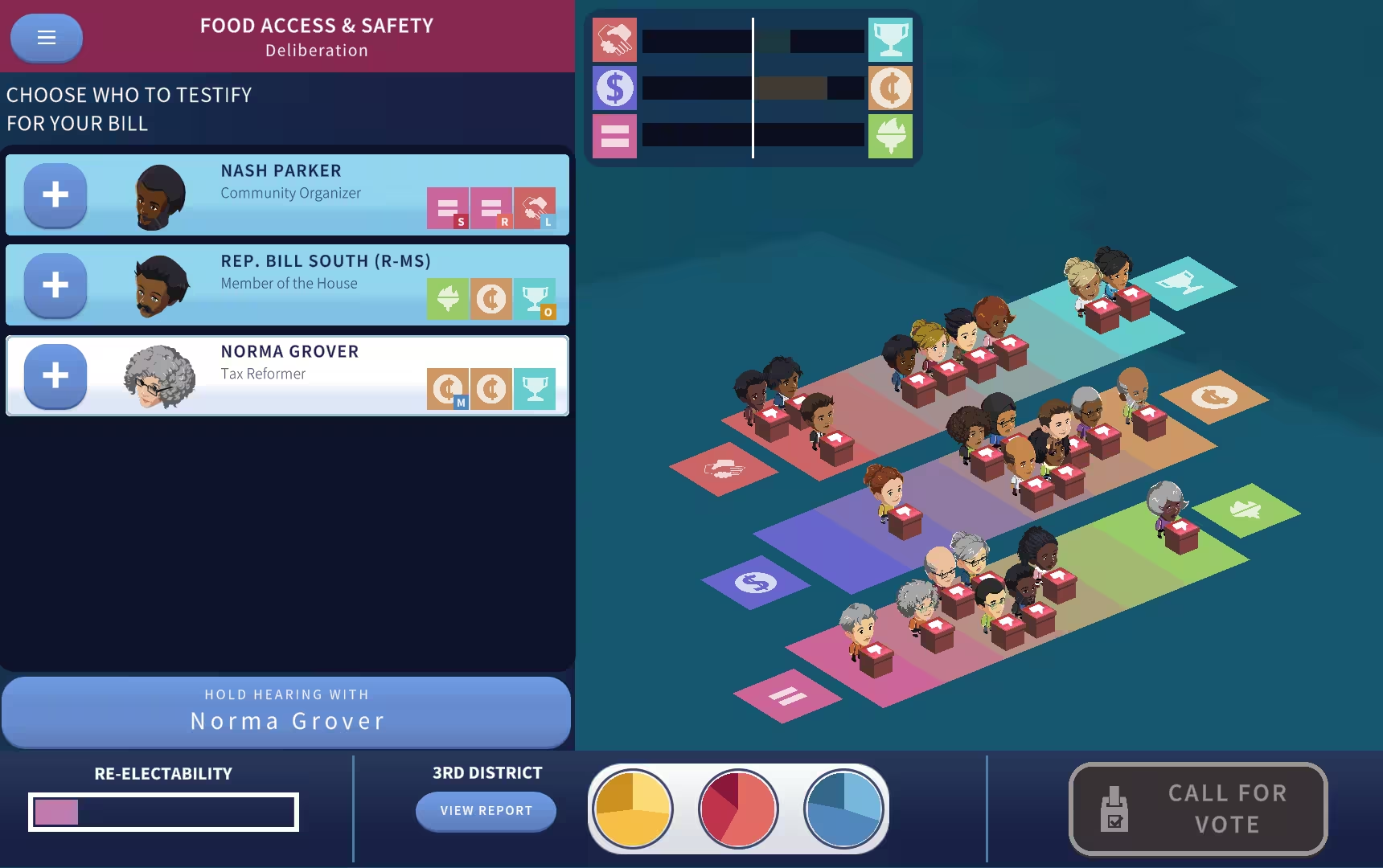
LawCraft is a civics learning game developed with iCivics that focuses on the lawmaking process of the U.S. Congress. Players represent a House district, review constituent input, and work through the legislative process to advance bills through the House and Senate.
Explore →Happy Monday, Filafriends! November is here, and so is a fresh installment of What's New in Game-based Learning. Here's what's hot 🔥 this month. Our own co-founder and CEO, Dan White, took to the pages of eSchool News to argue that educational equity should account for the learning experiences students can reach in addition to the resources their schools provide. Over in Australia, a team from the University of Sydney took on one of the most persistent logistical hurdles in higher education by building a way for libraries to license commercial games the same way they license films and journals. There's plenty more where that came from, including a statewide board game, a new research definition for youth health games, and a batch of educational minigames on YouTube. Read on for the full scoop!
West Virginia Gov. Patrick Morrisey visited Oak Hill in early October to unveil Mountain Moves, a new educational board game designed to teach eighth graders about state history, tourism, and the career opportunities available across West Virginia. In this Game of Life-inspired design for two to six players, each player is assigned a career connected to the state's tourism industry and advances by answering questions about West Virginia history and tourism, with content spanning the state's counties, parks, and rivers. Assigning each player a career identity is a smart design choice, since every correct answer moves forward a future that students can picture for themselves.
In a new column for eSchool News, Filament Games co-founder and CEO Dan White observes that conversations about educational equity usually center on resources, and he argues they should also ask whether students have access to the same learning experiences. Dan is clear that students should build physical robots and work with physical materials whenever possible, and he notes that for many students the alternative to a digital experience is often no experience at all. Over more than 20 years of building digital labs and simulations, we've seen a well-designed virtual experience introduce students to fields they might never have encountered otherwise.
A concept analysis published in Heliyon proposes a working definition of serious games in youth health education, bringing clarity to a field where serious games, gamification, and related digital tools are often treated as interchangeable. Using Walker and Avant's eight-step concept analysis method, the nursing-science researchers identified nearly 1,500 records and analyzed 30 publications to arrive at defining attributes including game mechanics, health-focused educational content, tailoring for youth, real-life relevance, interactivity, a safe environment for making mistakes, and feedback and assessment. The authors note that the framework is conceptual and call for more rigorous research across health topics and settings. If you're scoping a health game, the attribute list makes a useful checklist for your next project, especially its treatment of interactivity and feedback as core mechanisms of learning.
YouTube's six new educational Playables - which are free minigames that run in the app or on the web with no download required - include SuperNova from Black Girls Code, where players audition new bandmates and jam to new beats; Reset Mode from the Jed Foundation, a set of guided breathing and mindfulness exercises; Newton's Glider from Khan Academy, a physics puzzler about inertia and directional force; Elements of Truth from Veritasium, a science trivia game with confidence-based scoring; BackTrack Pro from TED-Ed, which teaches aspiring musicians to build chord progressions; and Lure of the Labyrinth: Vending Machine, presented by Math with Mr. J. That last one will ring a bell for longtime game-based learning fans, since it was developed in partnership with Maryland Public Television, the MIT Education Arcade, and FableVision Studios, the legendary team behind the classic Lure of the Labyrinth math game.
Writing for Times Higher Education's Campus section, four academics from the University of Sydney's Sydney Games and Play Lab argue that the biggest obstacle to teaching with commercial games in higher education is infrastructure. Universities have long-established systems for providing books, journals, films, and software, but digital games have mostly fallen outside of them, leaving instructors to improvise workarounds such as asking students to buy titles themselves. Their solution is Ludolio, an institutional subscription platform that lets libraries offer a curated catalog of commercial games through single sign-on, with participating developers receiving the majority of subscription revenue. Co-author Jen Scott Curwood earned her PhD in Curriculum and Instruction at UW-Madison, just down the road from our studio, so we're cheering this one on from Wisconsin!
~
That's all for this edition of What's New in Game-based Learning! Every month brings fresh evidence of how many different people are building, studying, and championing learning games, from state agencies and nonprofits to YouTube creators, nursing researchers, and university librarians. Each of them approaches the work with distinct goals and constraints, and the most successful projects are designed around those specifics from day one. If you're planning a learning game of your own, the same principle applies: the more clearly you define your learners and your intended outcomes, the stronger your game will be. As educational game developers with more than 20 years and hundreds of projects under our belt, we'd love to help you get there. Let's talk!
Best practices for preventing motion sickness while maximizing learning outcomes.
Best practices for preventing motion sickness while maximizing learning outcomes.
Get the latest Game-Based Learning Review content delivered to your inbox, including new articles, videos, and industry insights.