

Salvage Safari is a sustainability learning game developed with Niagara Cares that focuses on recycling practices and the circular economy. Players participate in multiplayer challenges within a shared environment, collecting, sorting, and disposing of waste to support environmental goals.
Explore →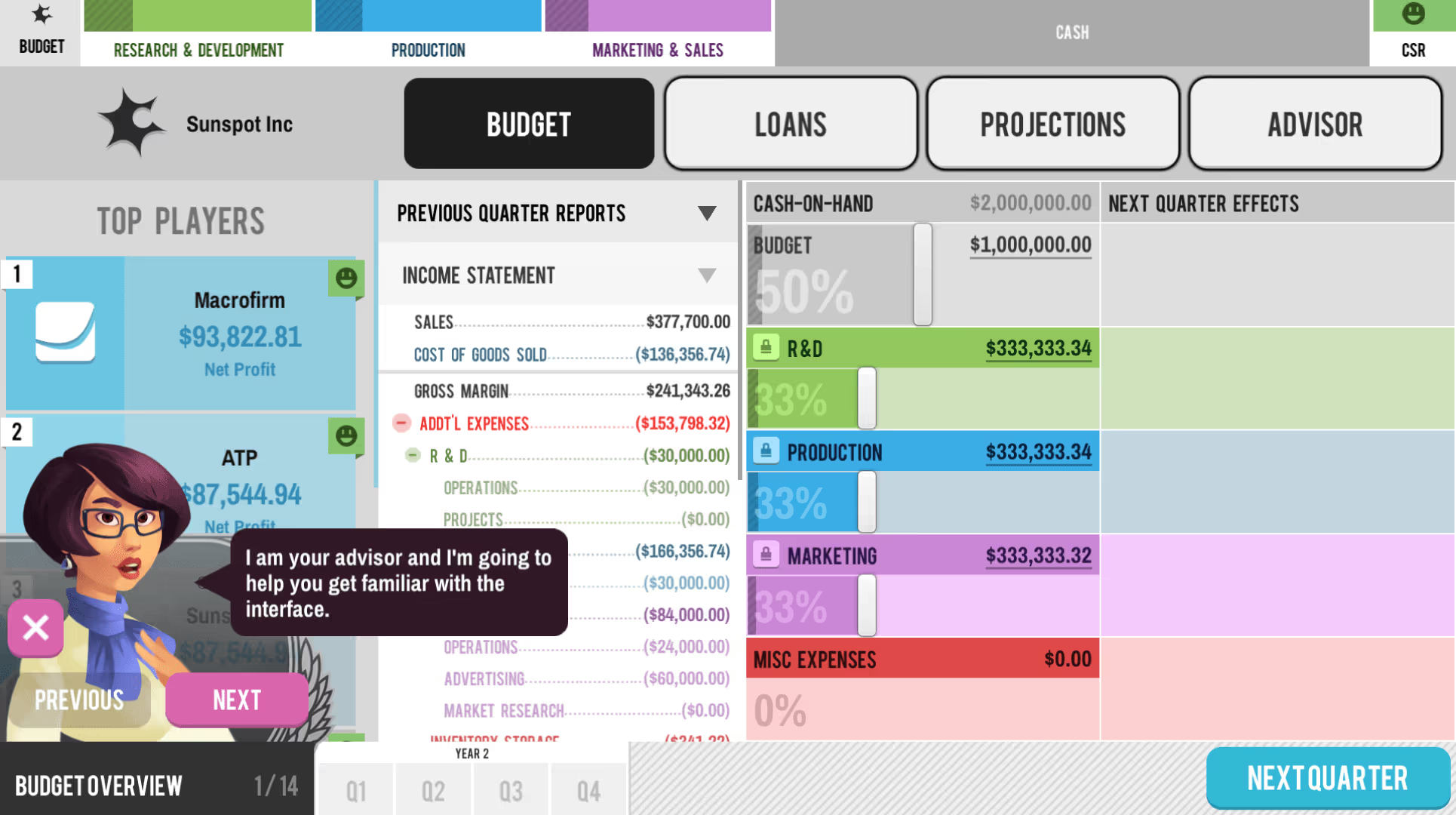
JA Titan is a financial literacy and business administration learning game developed with Junior Achievement that focuses on corporate decision making in a competitive market. Players take on the role of a company executive, making quarterly decisions about budgeting, production, and stakeholder priorities to improve business performance.
Explore →This is the first piece in an ongoing series about developing skillsets that position you for success in a creative enterprise. Central to my approach is the idea that I’ll explore one concept per article. I’ve gained my perspective directing small marketing teams, wherein skinny resource margins mean that incremental growth is more achievable than seismic change. If you manage an army of marketers or creatives of any kind, my advice might only be useful at the micro level for you. But maybe I’m wrong! Either way, I’d love to hear your thoughts on our Facebook or Twitter.
I’d like to first thank my colleague Alex Stone for bringing this topic to my attention (and the attention of the entire Filament Games management team) because I’m now going to shamelessly use this topic as the core of the first offering in this editorial series for which I’m taking full credit.
So that’s lesson #1 in creative enterprises – always take credit! (Kidding – although you should repurpose when possible. Extending the shelf life of your content is a great way to squeeze more value out of your work.)
Anyhow, onto the main course. The New York Times recently released an article called “What Google Learned from Its Quest to Build the Perfect Team” by Charles Duhigg in which team dynamics are explored in the context of the increasingly team-based world of business. Focusing on Google’s People Operations Department and their quest to create the perfect team, Duhigg examines some of the assumptions and the surprises that were encountered along the way.
As a mental exercise, the reader is asked to imagine two teams – team A and team B. Team A is rigidly process oriented, ostensibly efficient, and keeps conversations business-oriented without any social tangents. Team B is loose, jokey, spends work time talking about their personal lives, and is generally more informal in their approach. The intuitive response for me was to select Team A, where I would assume the margins for error are smaller and the vigilance for quality is higher, simply based on the group’s disposition. But I was wrong! Surprisingly, Google found that teams that resembled Team B are more effective on the whole than teams that resembled Team A. This is because Team B shares a trait that behavioral researchers call Psychological Safety.
So what is Psychological Safety? In the case of this study, it manifested in two key ways:
Again, these are two factors of Psychological Safety – a broader group norm that emphasizes mutual respect and candor. Think of a team you’re on – do you feel like you can speak fearlessly and candidly to that group? If so, congratulations! You’re on a team with strong Psychological Safety.
Based on these findings, we can infer that the more informal approach in Team B has the hidden effect of forcing team members to acknowledge each other as real human beings, rather than viewing them reductively as only colleagues, or worse, dependants. But that isn’t to say that emphasizing efficiency and process is the wrong move. These things simply need to be balanced with the behaviors that constitute Psychological Safety. You can read more about the concept of Psychological Safety here at JSTOR (registration required, but it’s free to read online).
As I reflect on ways to roll this type of thinking out to my team of marketing stalwarts, there’s not much I would change from the status quo, because they’re already so awesome. But if there was ever a day when they weren’t so awesome, here’s a few things I would suggest:
So how are you creating Psychological Safety on your team? If you have tips to share, let us know over on our Facebook or Twitter! And if there’s a specific topic you’d like to see us tackle here, please let us know! As I learned researching this article, building creative practices is a group effort.
Best practices for preventing motion sickness while maximizing learning outcomes.
Best practices for preventing motion sickness while maximizing learning outcomes.
Get the latest Game-Based Learning Review content delivered to your inbox, including new articles, videos, and industry insights.