
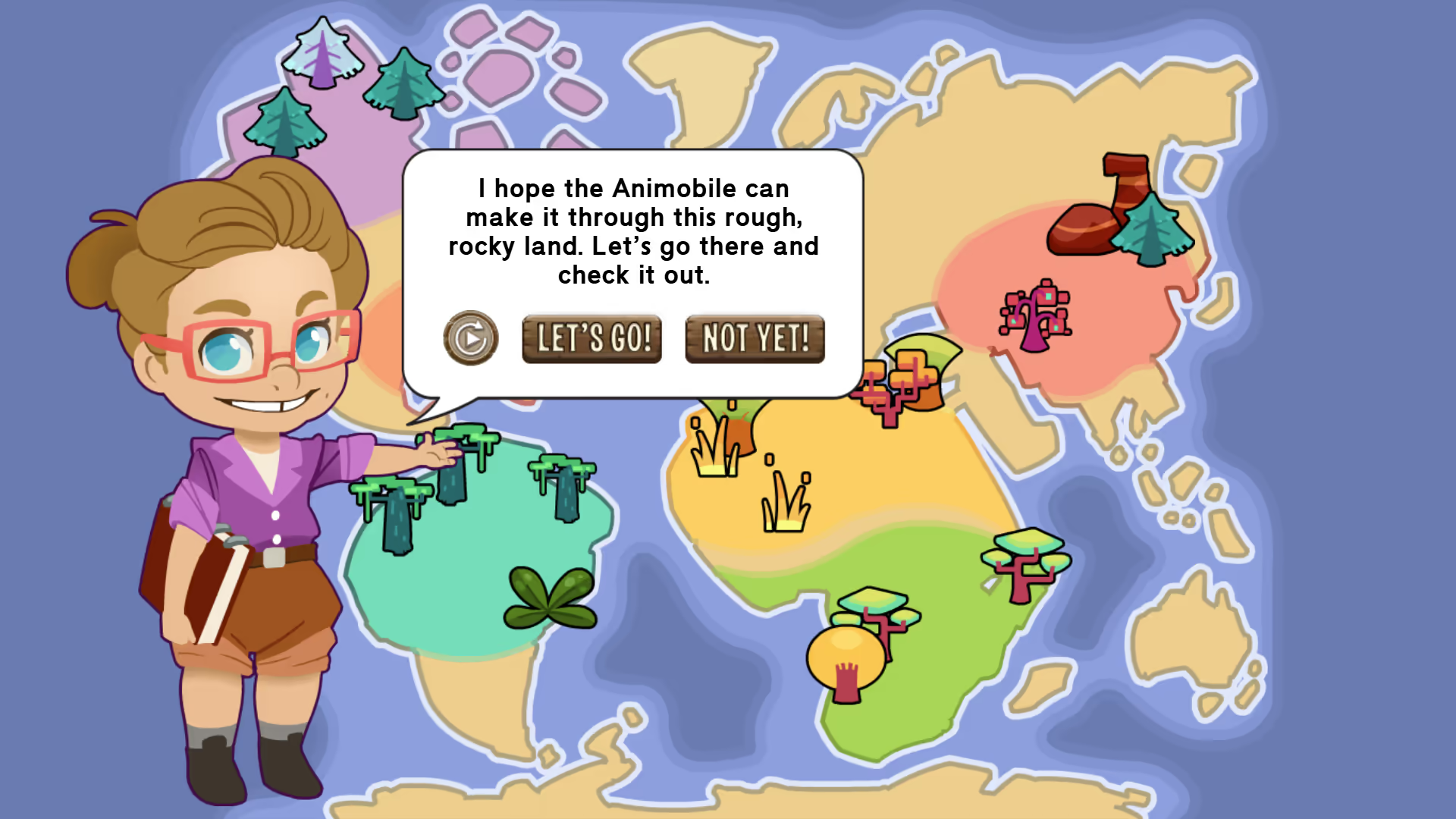
Animobile Adventures is a science learning game developed with McGraw-Hill that focuses on how animal traits interact with environmental conditions. Players travel to different climates, analyze habitat challenges, and modify their vehicle with traits and behaviors suited to each environment.
Explore →
Some Assembly Required is a VR robotics sandbox game developed by Filament Games for Meta Quest 2 and 3. Players design and build robots with intuitive hands-on controls to complete mechanical challenges and explore a secret-filled warehouse.
Explore →Every organization wants to keep its best people, and the most effective employee engagement and retention strategies start long before an exit interview. Employees tend to stay where they feel capable and see room to grow. Training is one of the most direct ways to deliver both, as long as the training itself is engaging. Purpose-built games give employees an active, low-stakes way to build skills from their first week onward, which makes them a natural fit for any retention strategy. Continuing our month-long look at employee engagement games, we examine the research connecting engagement and learning to retention, along with what it means for your next training initiative.
Gallup's 2024 Q12 meta-analysis drew on 736 research studies covering more than 183,000 business units and 3.3 million employees across 53 industries. Teams in the top quartile of engagement saw 51% lower turnover than bottom-quartile teams in low-turnover organizations, and 21% lower turnover in high-turnover organizations.
LinkedIn's 2025 Workplace Learning Report found that 88% of organizations are concerned about employee retention, and survey respondents ranked providing learning opportunities as their top retention strategy. Employees see the value too, with 84% agreeing that learning adds purpose to their work. Training employee engagement starts with the training itself. When a learning experience asks employees to make decisions and practice new skills, it delivers the growth they're looking for in a format they'll want to complete.
Gallup reports that only 12% of U.S. employees say their organization does a good job of onboarding. Employees who had an exceptional onboarding experience were 2.6 times as likely to be extremely satisfied with their workplace. A new hire's first weeks shape how they see the organization, which makes onboarding a strong place to introduce play. A well-designed onboarding game lets new employees explore your processes and practice their role at their own pace, building confidence well before their first performance review.
We developed Saving Lives! for Adtalem as a mobile simulation that trains healthcare students and professionals in American Heart Association guidelines for CPR and basic life support. Players perform chest compressions and use an AED as a patient's condition changes, with feedback tied to each action. As a testament to the quality of the design, Saving Lives! earned a gold award at the 2018 Serious Play Conference. This app shows how repeated practice in a safe environment helps employees feel prepared for the hardest parts of the job before they face them.
~
Retention grows from many small experiences, and training is the first of many small experiences your employees will encounter. When you build a game into your employee engagement and retention strategies, start with the skills your people need most and design practice they can repeat. Track how players progress so you can connect the program to your retention data over time. For more on making learning last, read our earlier look at knowledge retention and training with serious games, along with our broader guide to employee engagement games that build lasting skills. Interested in a training game designed to help your people grow with your organization? Let's talk.
Best practices for preventing motion sickness while maximizing learning outcomes.
Best practices for preventing motion sickness while maximizing learning outcomes.
Get the latest Game-Based Learning Review content delivered to your inbox, including new articles, videos, and industry insights.