
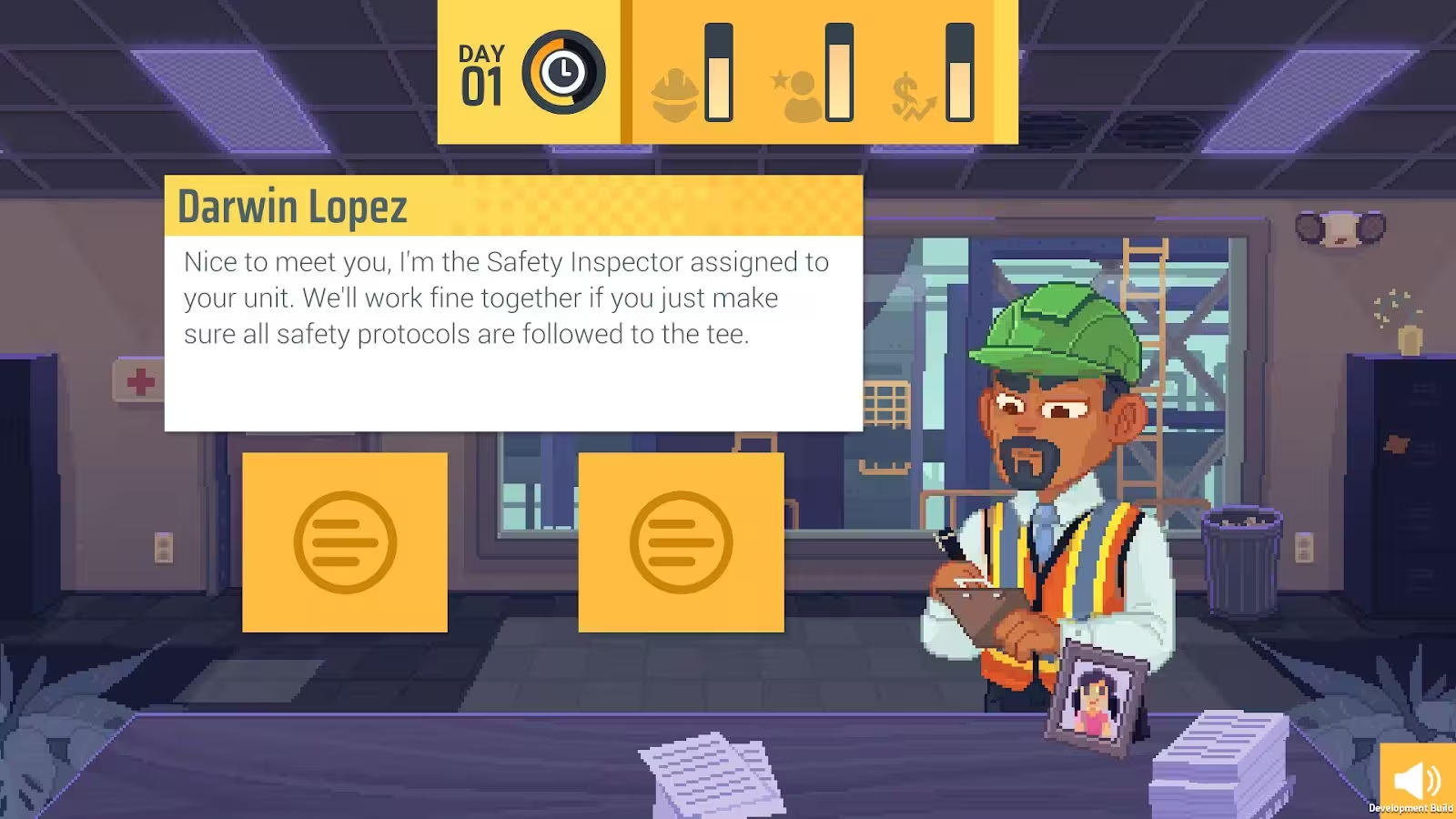
Contents Under Pressure is a safety and risk management game developed with Rowan University focusing on chemical plant operations. Players act as senior engineers, balancing production quotas with safety and reputation in high-stakes scenarios.
Explore →
Superkids World is a WCAG-compliant literacy game developed with Zaner-Bloser that focuses on reinforcing early reading skills through independent play. Players explore a shared environment with familiar characters and complete mini-games to practice foundational literacy concepts for K–2 students.
Explore →Corporate training in 2026 is moving away from passive content consumption toward active, skills-based simulations that drive measurable workforce improvement. We’re calling it now: the days of module box-checking and empty annual certifications are numbered – as organizations face rapid shifts in technical requirements and job roles, traditional e-learning models often fail to provide the depth of practice needed for high-stakes competency. As the World Economic Forum notes in its Future of Jobs Report 2025, 85% of employers plan to prioritize upskilling their workforce to address a rapidly shifting job market where nearly 40% of skills are set to change by 2030. Learning-first games address this by situating employees in authentic performance environments where they can apply new knowledge iteratively without operational risk. By prioritizing mastery over completion, companies can significantly reduce time-to-competency and improve the long-term retention of critical enterprise skills.
The most immediate return on high-fidelity simulations is a significant reduction in the time required for employees to reach full operational proficiency. Research published in Frontiers in Education (2025) finds that integrated digital learning environments are essential for managing cognitive load and optimizing learning outcomes through iterative practice. These environments create risk-free failure that users can easily embrace as constructive, which facilitates deeper knowledge retention than traditional methods. Filament Games applies these principles through projects like Saving Lives!, where healthcare professionals engage in high-pressure medical simulations to master life-saving protocols. By automating the feedback loop, these tools ensure that staff are prepared for real-world responsibilities in a fraction of the time required by classroom-based instruction.
Effective learning strategies are increasingly tied to concrete business outcomes such as revenue growth and the mitigation of support costs. Data from the Brandon Hall Group (2025) reveals that organizations implementing high-impact learning initiatives see a 36% increase in revenue generation and a 35% reduction in support costs. This financial dividend is achieved by developing deeper behavioral mindsets rather than just surface-level knowledge, a principle reflected in Junior Achievement’s RoboSellers, which simulates complex galactic trade to teach entrepreneurial and economic decision-making. When training moves beyond “how-to” content and into the development of results-oriented behaviors, the workforce becomes more efficient at identifying value and reducing errors in daily operations.
In industries facing persistent labor shortages, game-based learning serves as a critical tool for both attracting talent and reducing early-stage turnover. Gartner (2026) predicts that 40% of large warehouse and distribution operations will deploy gamification tools by 2028 to motivate workforces and reduce time-to-competency for seasonal staff. These tools improve retention by providing clear visibility into developmental progress and building employee confidence through interactive achievement systems. By creating a more engaging and supportive onboarding experience, organizations can secure their talent pipeline and maintain higher productivity levels across the enterprise. High-fidelity simulations like MSI Retail Sim that model interpersonal dynamics and organizational culture allow new hires to navigate complex workplace scenarios in a safe environment, addressing the social drivers of satisfaction that traditional HR modules often fail to reach.
The ultimate metric for any corporate upskilling initiative is the percentage of learners who can immediately apply their new skills to real-world tasks. Studies by Game2Change (2025) found that 86% of learners reported having skills they could apply immediately after completing a game-based compliance program. This high rate of transferability is due to the inherent structure of games, which require active participation and decision-making rather than the passive observation typical of video-based courses.
–
Filament Games leverages more than twenty years of experience in evidence-based design to ensure that every game mechanic is tightly coupled with a specific learning objective. This focus on instructional rigor ensures that the well-played game translates directly to a well-learned skill, providing a quantitative case for the continued adoption of game-based learning at scale. Interested in exploring game-based learning in your organization? Let’s talk.
Best practices for preventing motion sickness while maximizing learning outcomes.
Best practices for preventing motion sickness while maximizing learning outcomes.
Get the latest Game-Based Learning Review content delivered to your inbox, including new articles, videos, and industry insights.