

NewsFeed Defenders is a civics and media literacy learning game developed with iCivics. Players moderate a fictional social media platform, balancing audience growth with decisions about removing or limiting misleading, biased, or deceptive content.
Explore →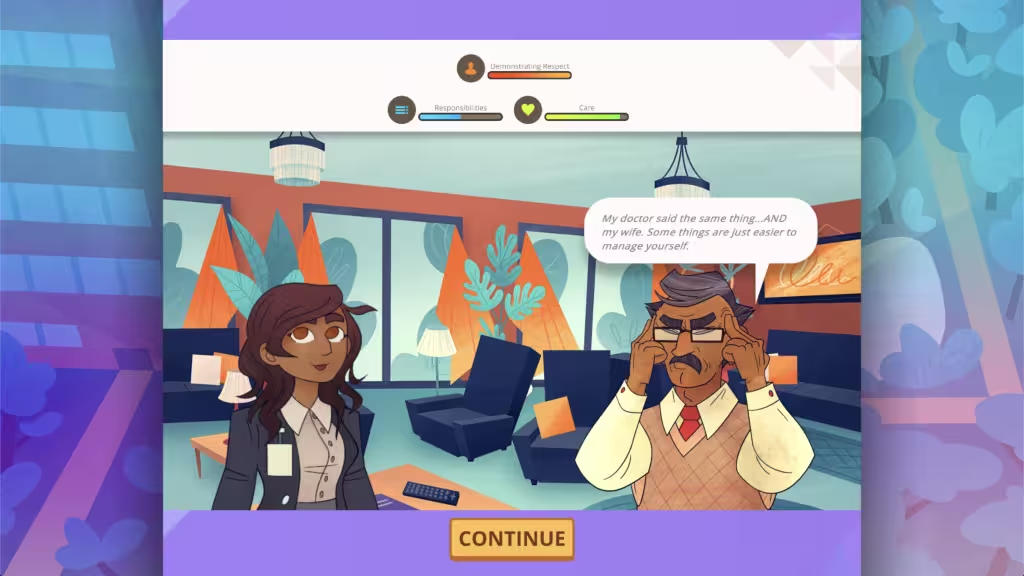
Demonstrating Respect Game is a healthcare training simulation developed with the Mental Health Association of Maryland. Players practice communication and empathy while providing person-centered care to older adults.
Explore →Game-based learning is often discussed as a modern response to new technology, so it might surprise you that many of its most effective ideas were established decades ago, shaped by institutional needs, limited hardware, and the realities of teaching at scale. Let’s hop in our Filament DeLorean and take a look at a few lesser-known moments from that history – moments that explain why certain approaches continue to work so well today.
The original version of The Oregon Trail was created in 1971 by Don Rawitsch, Bill Heinemann, and Paul Dillenberger while they were student teachers in Minnesota. It was designed to support a specific classroom lesson on westward expansion, not as a commercial game or consumer product. When the Minnesota Educational Computing Consortium later adopted the game, its instructional purpose remained central. MECC treated The Oregon Trail as curriculum infrastructure, updating it over time to match classroom needs, available hardware, and district requirements. Its long lifespan came from institutional alignment and educational relevance rather than novelty.
Speaking of the Minnesota Educational Computing Consortium – the organization was created to help schools share computing resources and instructional software. Games like The Oregon Trail and Number Munchers were distributed as part of a coordinated statewide strategy, not as isolated titles. This approach positioned learning games as durable tools rather than one-off products. Updates were driven by teacher feedback and classroom realities, and distribution was tied directly to public education systems. Many assumptions behind modern learning platforms were already present in this model.
Beginning in the 1960s, the PLATO system at the University of Illinois supported thousands of terminals across universities, schools, and research institutions. It included real-time chat, forums, shared notes, and multiplayer games designed specifically for learning contexts. Features now associated with modern educational games, such as collaboration, competition, persistent identities, and immediate feedback, were already in use. These mechanics were not entertainment features added later. They were core components of computer-assisted learning environments built to support independent and peer-based study.
Outside K12 education, healthcare training played a significant role in shaping simulation-based learning. Medical simulations were developed to help students and professionals practice decision-making, procedural skills, and teamwork in controlled environments where mistakes could be examined without real-world harm. These systems emphasized feedback, repetition, and scenario variation. Many design principles that appear in modern learning games, such as safe failure, performance-based assessment, and iterative practice, were refined through this work and later adapted for broader educational use.
–
These early examples show that game-based learning has long been shaped by real constraints and real goals. Designers worked closely with educators, public institutions, and practitioners to build experiences that were clear, repeatable, and resilient across contexts. That continuity is still useful today! Modern tools make it easier to implement and scale these ideas, and the underlying principles remain consistent and reliable producers of great learning. When learning games align purpose, design, and context, they tend to endure. Looking to make your own mark on game-based learning history? Let’s talk.
Best practices for preventing motion sickness while maximizing learning outcomes.
Best practices for preventing motion sickness while maximizing learning outcomes.
Get the latest Game-Based Learning Review content delivered to your inbox, including new articles, videos, and industry insights.