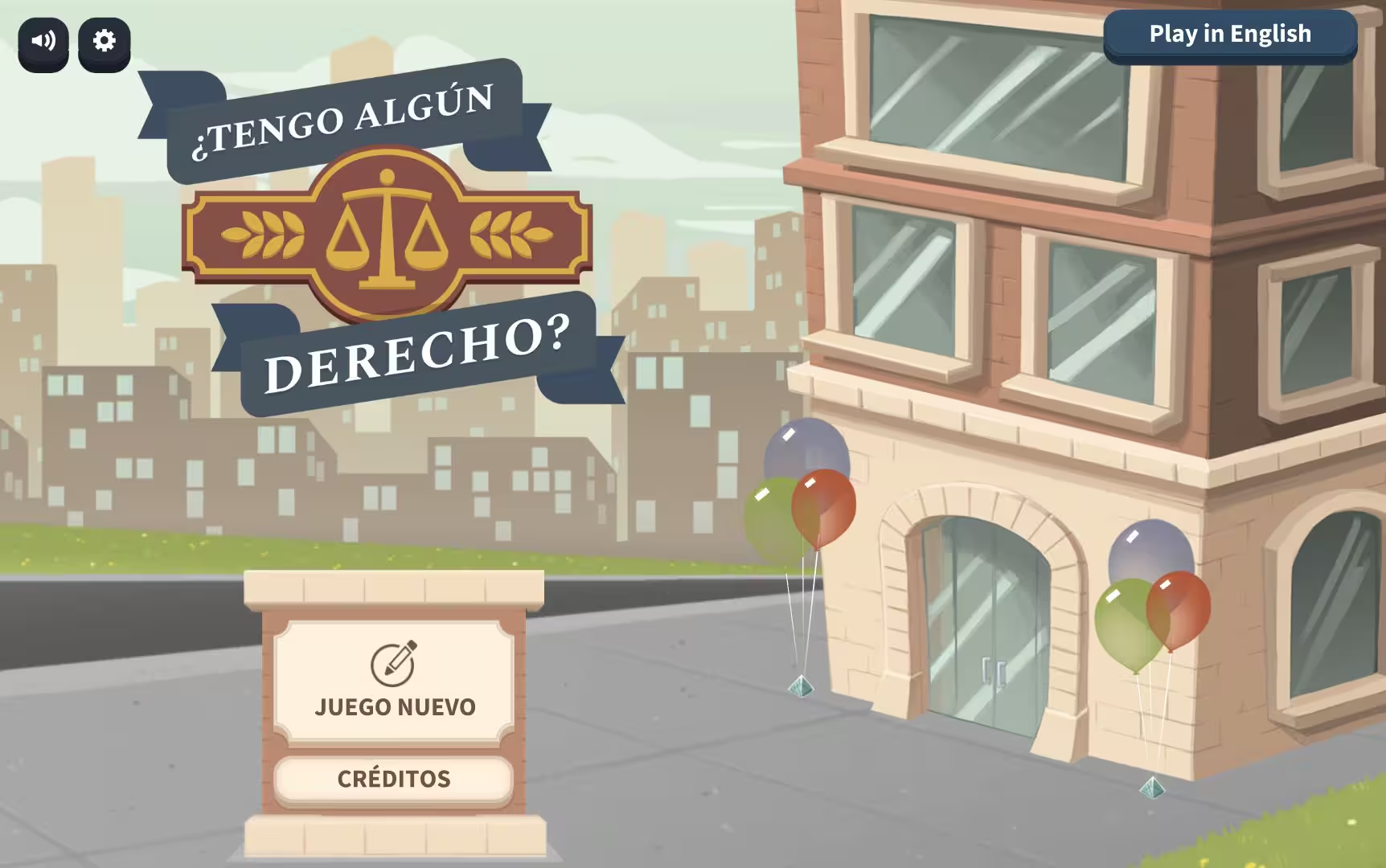
Do I Have a Right? is a civics learning game developed with iCivics that teaches constitutional law through interactive legal scenarios. Players run a law firm, determine whether clients’ rights have been violated, and argue cases based on the Bill of Rights.
Explore →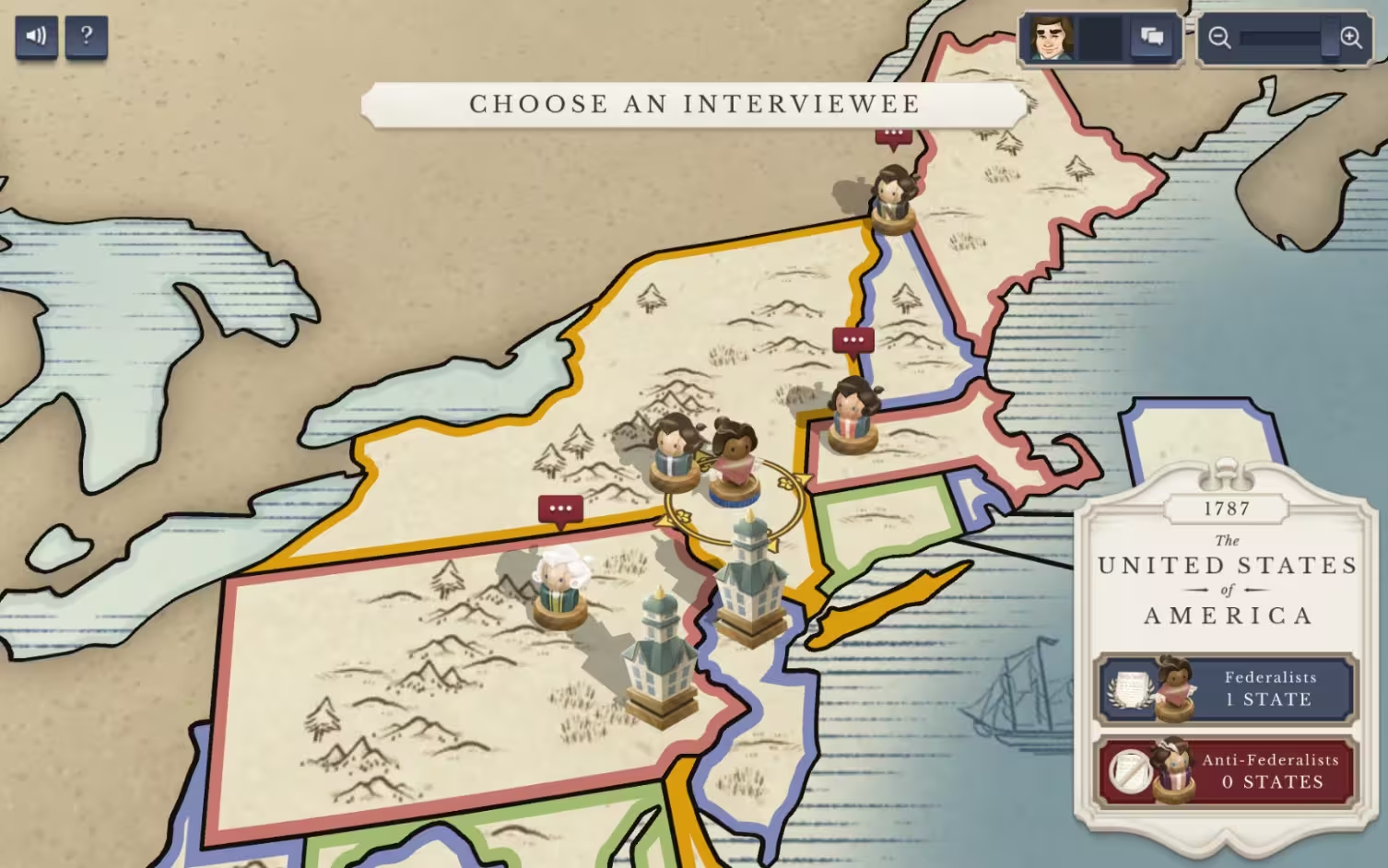
Race to Ratify is a civics learning game developed with iCivics that focuses on the debate over ratifying the U.S. Constitution. Players take on the role of a pamphleteer aligned with either the Federalists or Anti-Federalists, traveling across the thirteen states to gather arguments and influence public opinion.
Explore →The new school year is officially underway, and the conversation around AI in education came back from summer break louder than ever. We've gathered five stories worth your attention, four of them looking back across the past month and one early-September development that was just too darn significant to hold for next month’s issue. A tech mogul sounds a warning about critical thinking, a hands-on classroom pilot puts numbers to what students actually retain, a top research university turns the lens on its own teaching, the country's largest school district makes a sweeping policy call, and a peer-reviewed perspective reframes what it even means to learn from a machine. Read on and be enriched with the latest findings in AI and learning!
Bill Gates has grown noticeably more worried about AI than he was a few years ago. In a long essay on his GatesNotes site, he argues that the same tools that let people learn more than ever could also lead many to learn less, pointing to 2025 research that links heavier AI use to weaker critical thinking, especially among younger users. Gates offers an upside too. He describes the version of AI he wants to see: one that explains a new idea in full when a student first meets it, then holds the answer back later so the student reaches it on their own. Protecting the cognitive work that builds understanding is a principle we build every learning game around.
A practitioner writing in The 74 shared results from a week-long AI pilot she ran with newcomer and refugee students, ages 11-17, at a Chicago nonprofit. Each day they studied a short reading with AI in a different mode - some days it summarized the passage, other days it ran a Socratic back-and-forth that made them reason through it. A day later, students averaged 83% on the material they had reasoned through and 67% on the material the tool had summarized for them. Their confidence climbed all week while tracking almost nothing about what they actually retained. For anyone weighing an edtech contract, the signal to track is retention once the help is gone, because the mode that made students do the reasoning is the one where the lessons lasted.
An MIT committee of students, faculty, and staff spent months studying AI on campus and concluded it is upending foundational parts of the MIT experience, from how instructors gauge mastery to how connected students feel, with grading drawing the sharpest attention. The report advises against capping the number of A's, as some universities have done, and urges MIT to reconsider what grades are for at all, exploring competency- and mastery-based systems. The committee's logic is that if grades mattered less, many of the incentives to cheat with AI would fall away on their own. It’s an interesting question, and similar to questions we’ve posed before about the nature of assessment in the educational process.
New York City rolled out what it calls the nation's broadest student-facing generative AI moratorium, effective this school year and reaching close to 600,000 students, which amounts to two-thirds of enrollment. For grades 2-K through 8, student-facing generative AI is paused, and companion chatbots are prohibited across every grade. The policy carves out a narrow exception for a small set of pilots, capped near 50,000 high schoolers, which will run under direct teacher supervision, with each tool vetted for safety and chosen to keep students as the primary thinker. However you read the pause, the design brief inside those pilots will include tightly bounded time under a trained educator, with the reasoning left to the learner.
The month's most technical entry, a Nature Communications perspective, turns the usual question around and asks what humans can learn from AI systems that already outperform experts at certain scientific and engineering tasks. The authors make the case for methods that pry open a model's internal reasoning so researchers can pull testable hypotheses from it and audit high-stakes systems before deployment. They advocate for a model with reasoning you can inspect, which makes it a model you can generalize from and hold accountable.
~~
None of these stories agree on exactly what schools should do next, which is a fair picture of where things stand right now. What game-based learning offers is a design stance that anyone can agree with, putting the learner in the active role, and keeping the focus on retention once the learning process concludes. This is the craft behind every game and simulation we build. Interested in building a learning game that keeps students thinking? Let's talk.
Best practices for preventing motion sickness while maximizing learning outcomes.
Best practices for preventing motion sickness while maximizing learning outcomes.
Get the latest Game-Based Learning Review content delivered to your inbox, including new articles, videos, and industry insights.