


Executive Command is a civics learning game developed with iCivics that focuses on the roles and responsibilities of the U.S. presidency. Players take on the role of the president, balancing legislative priorities and executive duties while managing competing national demands.
Explore →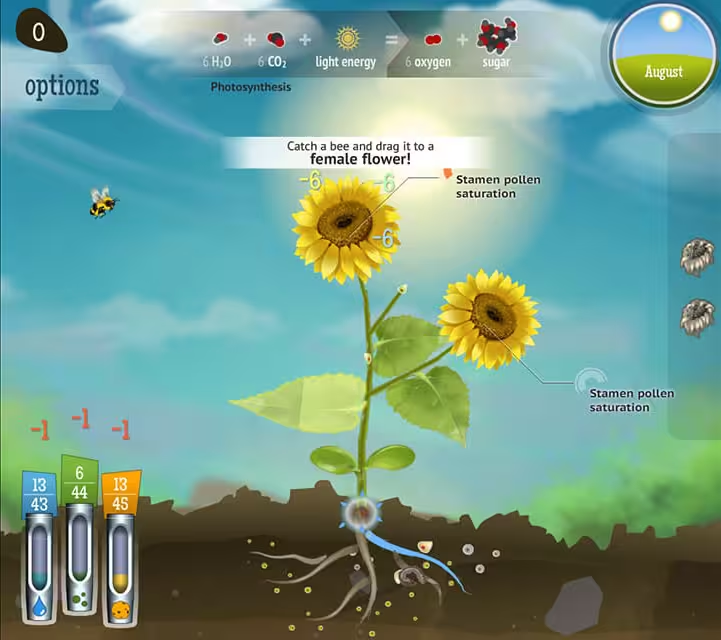
Reach for the Sun is a plant growth learning game developed by Filament Games that teaches photosynthesis and plant life cycles. Players grow a plant from seedling to maturity, managing environmental challenges and seasonal change through interactive play.
Explore →Earlier this month we covered what counts as proof that a learning game works and how to report that evidence to teachers. Enterprise training asks the same question in different vocabulary, and the answer has to survive the scrutiny of a budget review. In many training and teaching contexts, soft skills often carry a reputation for being difficult to measure. Fortunately, through the power of game-based learning and a well-designed simulation, soft skills can start to be observed as they emerge.
For corporate project, we generally scope based on the operational number the training is meant to move. Safety incidents, first-call resolution, ramp time to productivity, and voluntary turnover can all serve this purpose. That goal determines what the game has to observe, which makes it the most consequential decision in the procurement. A program scoped without a clear metric will produce completion data which has its uses, but if you have a specific metric you’re looking to improve, the educational game design should be built around it explicitly.
Soft skill language resists measurement if it remains abstract. An objective like improving communication gives a design team very little to build against. By contrast, resolving an upset customer's complaint without transferring the call gives them a scenario, a set of options, and a scoring model. Turning a competency into verbs is where our design process begins on any project, and those verbs in turn inform the mechanical design of the game.
A well-designed simulation has the capacity to observe behavior while it happens. Research published in JMIR Serious Games argues that games are ideal for soft skill assessment because these skills can be evaluated across varied contexts and methods, and because gameplay surfaces characteristics that are complicated to observe by other means. When an employee de-escalates a scripted customer, allocates a budget under time pressure, or decides whether to raise a safety concern, the system records the decision along with the conditions surrounding it. Evidence gathered this way arrives immediately and covers everyone who played, which compares favorably to a sampled follow-up survey administered a month after the session.
For an example of these ideas in practice, take a look at Mooving Cows, which we built with the University of Wisconsin-Madison. This playful simulation trains dairy farm personnel in low-stress cattle handling. Players take the role of a cow mover, guiding animals through barns and pathways using calm movement and careful positioning, and the game asks them to regulate their own frustration while doing it. Frustration regulation is a soft skill by any definition, and here it becomes observable as a sequence of handling decisions rather than a self-report. The business case sits directly alongside the learning objective, since calmer handling supports herd health, milk yield, and worker safety, all of which a dairy operation already measures.
High-fidelity workplace simulations such as MSI Retail Sim are built around interpersonal dynamics and organizational culture, giving new hires a place to work through complicated situations before encountering them in real life. The World Economic Forum's Future of Jobs Report 2025 found that 85% of employers plan to prioritize upskilling their workforce, with close to 40% of skills expected to change by 2030, and a considerable share of that shift involves judgment and interaction rather than technical procedure. Simulation suits this category of skill because the competency only becomes visible through actions taken in context.
Most operational metrics worth building a training program around are already recorded somewhere in the organization. Designing a successful training intervention will involve locating that data and arranging access rather than standing up new instrumentation. We create a baseline for the metric before the first cohort plays, keep a not-yet-trained comparison group where the rollout schedule allows one, and this allows us to have the comparison we need to measure impact.
A game changes what an employee is capable of doing, and the surrounding conditions determine whether they do it. Manager reinforcement, aligned incentives, and the practical opportunity to apply a new approach all shape whether trained behavior appears in the workflow. Planning those supports alongside the rollout protects the investment and strengthens the numbers you report, particularly when the ultimate aim is to build something that the organization can repeat with the next cohort.
~
Corporate buyers get more from game-based training when the measurement plan forms part of the purchase rather than a question raised after launch. Name the business metric, describe the target behavior in verbs, and the evidence design begins to form, as if by magic - and yes we are referring to the magic of game-based learning. Interested in building measurable behavior change into your next training program? Let's talk!
Best practices for preventing motion sickness while maximizing learning outcomes.
Best practices for preventing motion sickness while maximizing learning outcomes.
Get the latest Game-Based Learning Review content delivered to your inbox, including new articles, videos, and industry insights.