

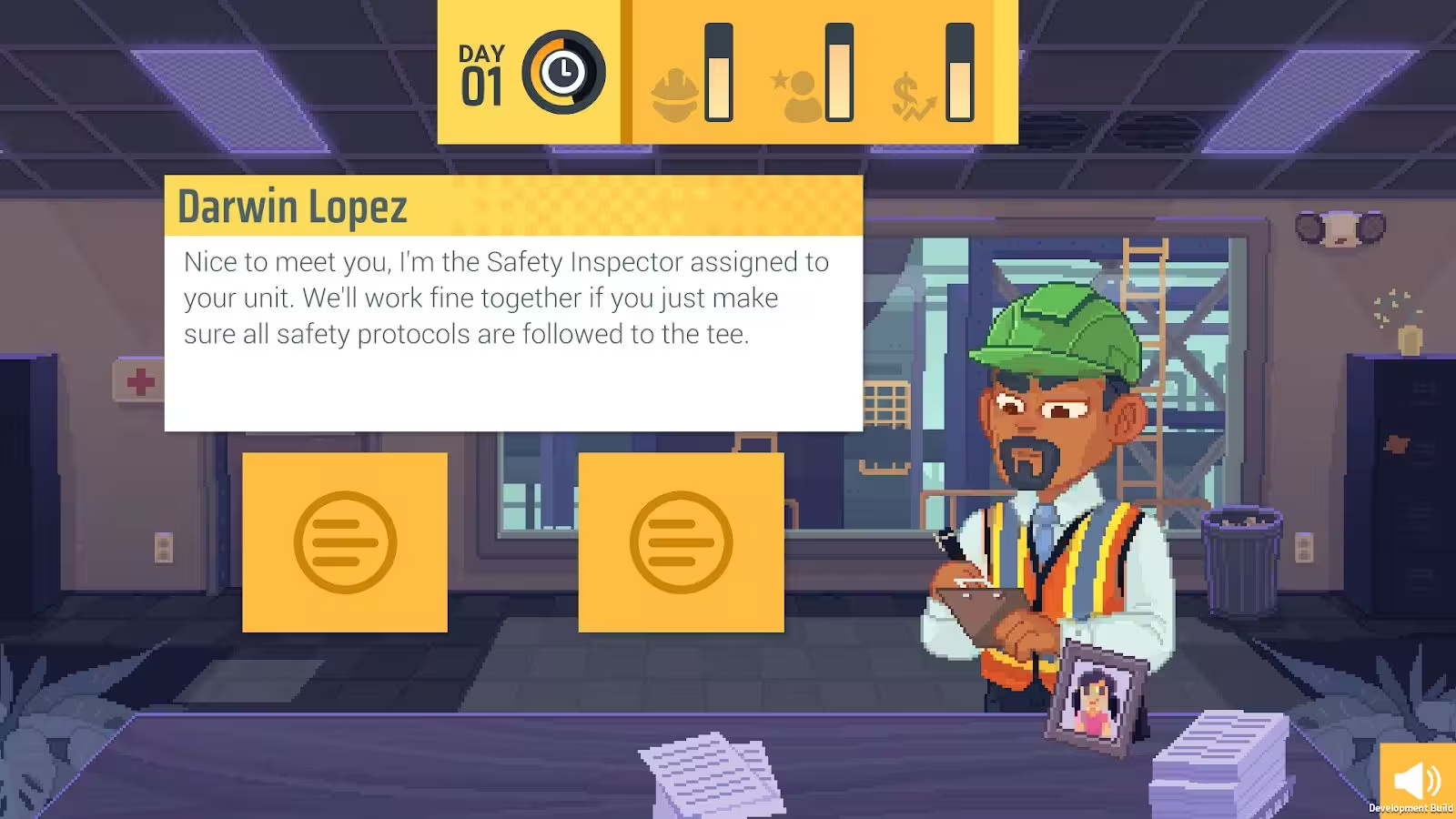
Contents Under Pressure is a safety and risk management game developed with Rowan University focusing on chemical plant operations. Players act as senior engineers, balancing production quotas with safety and reputation in high-stakes scenarios.
Explore →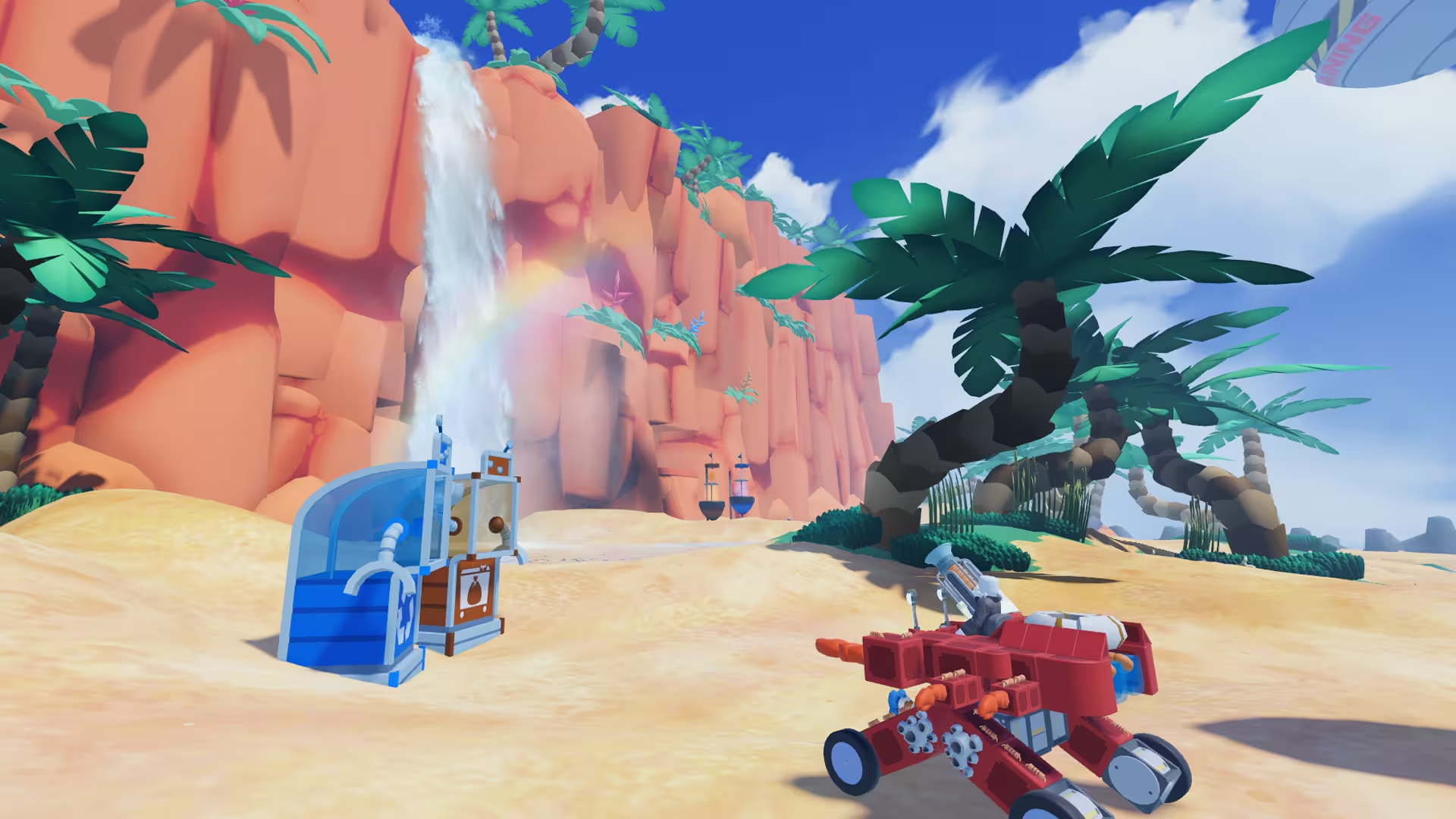
Salvage Safari is a sustainability learning game developed with Niagara Cares that focuses on recycling practices and the circular economy. Players participate in multiplayer challenges within a shared environment, collecting, sorting, and disposing of waste to support environmental goals.
Explore →Training formats tend to persist long after the conditions that created them. Workshops, webinars, and slide-based courses remain common because they are familiar and operationally simple. Over time, those choices shape cost, consistency, and outcomes in ways that are rarely examined. Long-term return on investment is influenced less by the amount of content delivered and more by whether the format supports repeated practice, consistent delivery, and transfer to real situations. Recent research across education and workforce learning shows that interactive games and simulations often perform better on those dimensions when the learning goal involves application rather than awareness.
Traditional formats have a way of driving long-term costs. Live and passive formats reset with each cohort. Workshops require repeated facilitation. Webinars live and die based on attendance and attention in an increasingly distracting world. Slides rely on follow-up that may or may not occur. These patterns increase cost over time while introducing variability in outcomes. Indeed, a 2024 second-order meta-analysis of digital learning tools found that learning gains are closely tied to how a format shapes learner activity. Tools like learning games which require active engagement show stronger effects than formats that primarily deliver information, particularly when learning is expected to persist beyond the training window. This has significant implications for controlling long-term training costs!
Slide decks and linear training modules are effective for introducing concepts and providing reference material, but their impact diminishes when the objective involves retention and application weeks later. Interactive games require learners to act on information repeatedly, which bakes in retention. This is because progress depends on motivated decisions rather than recognition. Research on technology-enhanced learning environments consistently shows that formats demanding active participation support stronger learning outcomes than those that replicate passive instruction in digital form.
Workshops support discussion and shared context, but are less effective as a repeated delivery mechanism for skill development, particularly when practice time is limited and outcomes vary with facilitation quality. Simulation-based games shift practice into a reusable system. A 2025 review of serious games in nursing education found consistent improvements in knowledge application and decision-making across studies, driven by repeated exposure to realistic scenarios. This pattern aligns with findings across professional training domains, where opportunities to rehearse decisions under controlled conditions support learning goals that live sessions struggle to address at scale.
While webinars scale information distribution efficiently, they provide limited opportunities for rehearsal and feedback, which affects retention and later performance. A 2025 study published in JMIR Serious Games found that interactive game-based learning environments supported higher engagement and stronger applied outcomes than less interactive digital formats in professional training contexts. This suggests webinars remain useful for communication and orientation, while interactive formats are better suited to learning goals tied to behavior and performance.
The economic value of interactive formats becomes even clearer in settings where mistakes carry real cost. Safety procedures, compliance scenarios, and operational workflows benefit from rehearsal without real-world consequences. A 2024 review of serious games used in cardiopulmonary resuscitation training found comparable skill outcomes to traditional instruction and supports their use within blended programs to improve learning quality. Experimental work in simulated environments also shows that interactive formats perform better than passive exposure when tasks involve judgment, timing, and interpretation.
–
Choosing a training format is a strategic decision with long-term implications. Interactive games and simulations are not a universal solution, but they offer a stronger return when learning goals extend beyond awareness and into performance. Evaluating format choices through a long-term ROI lens helps organizations invest in systems that support outcomes across time rather than one-off delivery. Looking to make an investment in your training programs that keeps your costs down in the long term? Let’s talk!
Best practices for preventing motion sickness while maximizing learning outcomes.
Best practices for preventing motion sickness while maximizing learning outcomes.
Get the latest Game-Based Learning Review content delivered to your inbox, including new articles, videos, and industry insights.