

NewsFeed Defenders is a civics and media literacy learning game developed with iCivics. Players moderate a fictional social media platform, balancing audience growth with decisions about removing or limiting misleading, biased, or deceptive content.
Explore →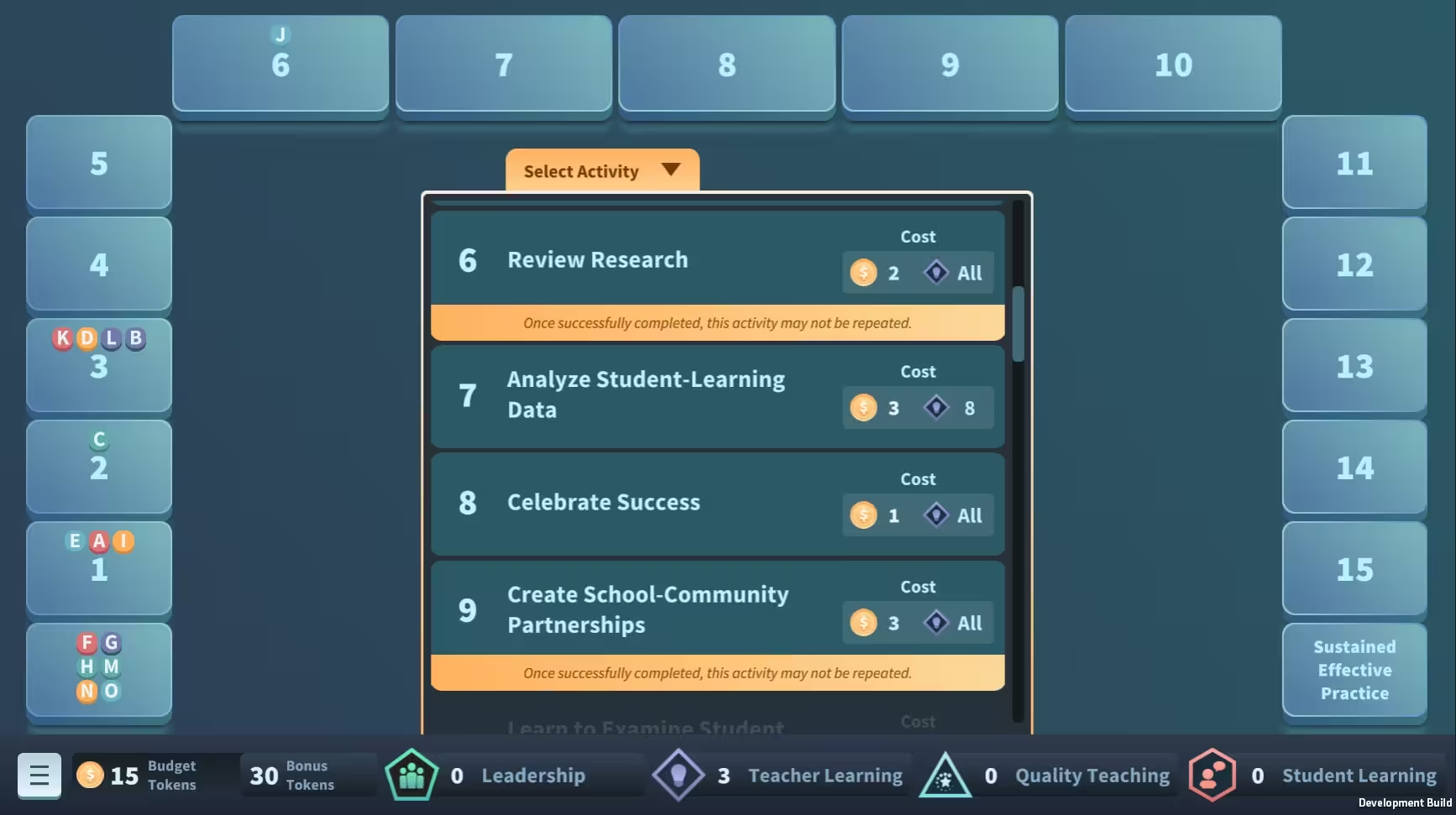
Leading Professional Learning is a professional development simulation developed with WestEd that focuses on preparing school leaders to design and implement effective teacher learning experiences. Players engage with realistic scenarios that reflect common school challenges.
Explore →Happy Monday, Filafriends! As educational game developers par excellence, we know that a good educational game is only half the job. The other half is everything standing between a finished game and a student actually playing a game in a real classroom, from the login screen to the privacy paperwork to the screen reader to the school's Wi-Fi idiosyncrasies. This August we focused on that second half of the equation, exploring and demystifying the technical hurdles that educational game developers sometimes encounter when taking games to the market, and to scale. Read on for a recap of the requirements to make your next game project ready for mass EDU adoption!
Ask us what makes an educational game succeed and we will happily talk your ear off about mechanics, verbs, identities, and systems. But that’s just the beginning! We can also talk about the LTI standard, which is how a game launches cleanly inside a learning management system that districts already run. Google Classroom and Canvas together serve close to three-quarters of U.S. classrooms according to ListEdTech's May 2026 data, and CoSN's survey of 607 district leaders ranks integration headaches high on the list of technology pain points. LTI 1.3 is the solution to this issue - a standardized way to simply and streamline integration.
Every game we build for a classroom is built for kids, and that single fact shapes the software before the privacy policy has even been outlined. This post walks through why privacy has to be an architectural decision from the start, tracing the April 2026 COPPA update through GDPR's principle of data protection by design. The Student Data Privacy Consortium's national agreement registry now holds more than 130,000 signed agreements and has saved districts and vendors roughly $111 million in legal costs since 2016 - make sure you have a deep understanding of these federal policies to keep your project in-bounds.
Here’s some food for thought. The bottleneck for game-based learning is usually infrastructure, and teacher enthusiasm rarely gets a fair test until the network cooperates. Drawing on Quizlet's readiness study, this post shows how broadband and device access predict where a state lands more reliably than measured interest does, and there are significant gaps depending on the regions you’re considering. SETDA's guidance to plan for up to 2.8 megabits per second per student at peak is a useful reminder that we need design for the hardware realities of schools and districts.
An educational game can pass an automated accessibility scan and still leave a student who uses a screen reader unable to play it. This post makes the case that WCAG 2.1 Level AA compliance has to be engineered into a game's design, and it explains how our FUAT technology builds a structured content layer for canvas-based games, covering roughly 40 percent of the WCAG 2.1 AA criteria out of the box. With the ADA Title II deadlines arriving in April 2027 and April 2028, this is an urgent topic to wrap your head around.
~
The studios that will do well over the next few years are the ones treating integration, privacy, accessibility, and classroom readiness as design decisions they make early. It also just so happens to be the work we love most - while it’s not strictly game design, these accessibility measures are a critical path towards maximizing the positive impact we want to make on the world. If you’re thinking about a custom educational game that has to hold up in a real classroom, let's talk.
Best practices for preventing motion sickness while maximizing learning outcomes.
Best practices for preventing motion sickness while maximizing learning outcomes.
Get the latest Game-Based Learning Review content delivered to your inbox, including new articles, videos, and industry insights.