

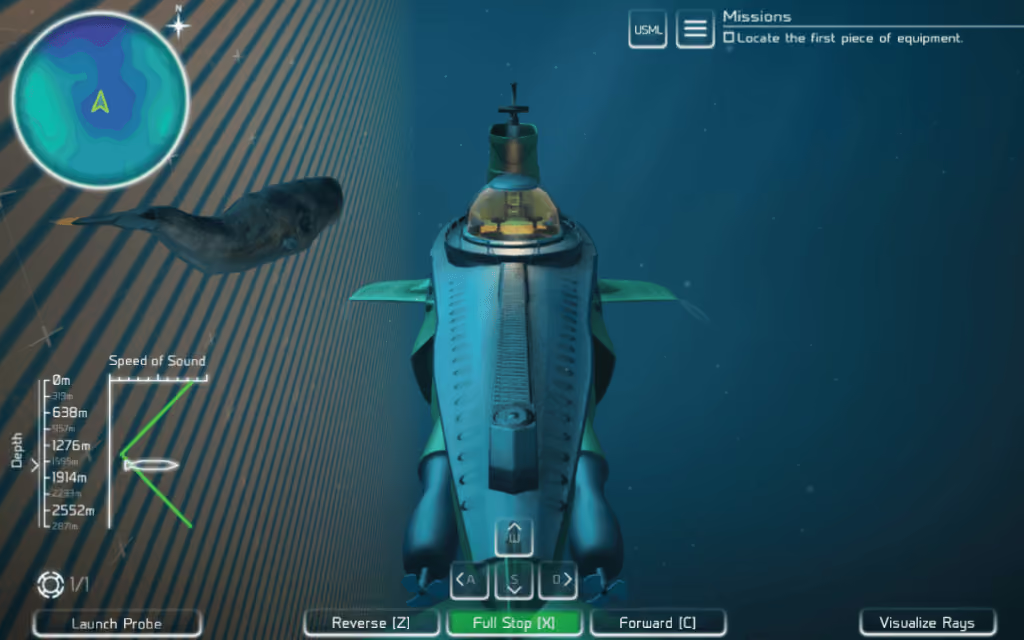
WaveQuest is an interactive learning game developed for ARIA and the Office of Naval Research that supports both STEM education and professional sonar training. Players explore the scientific principles of underwater acoustics through mission-based gameplay and real-time simulation.
Explore →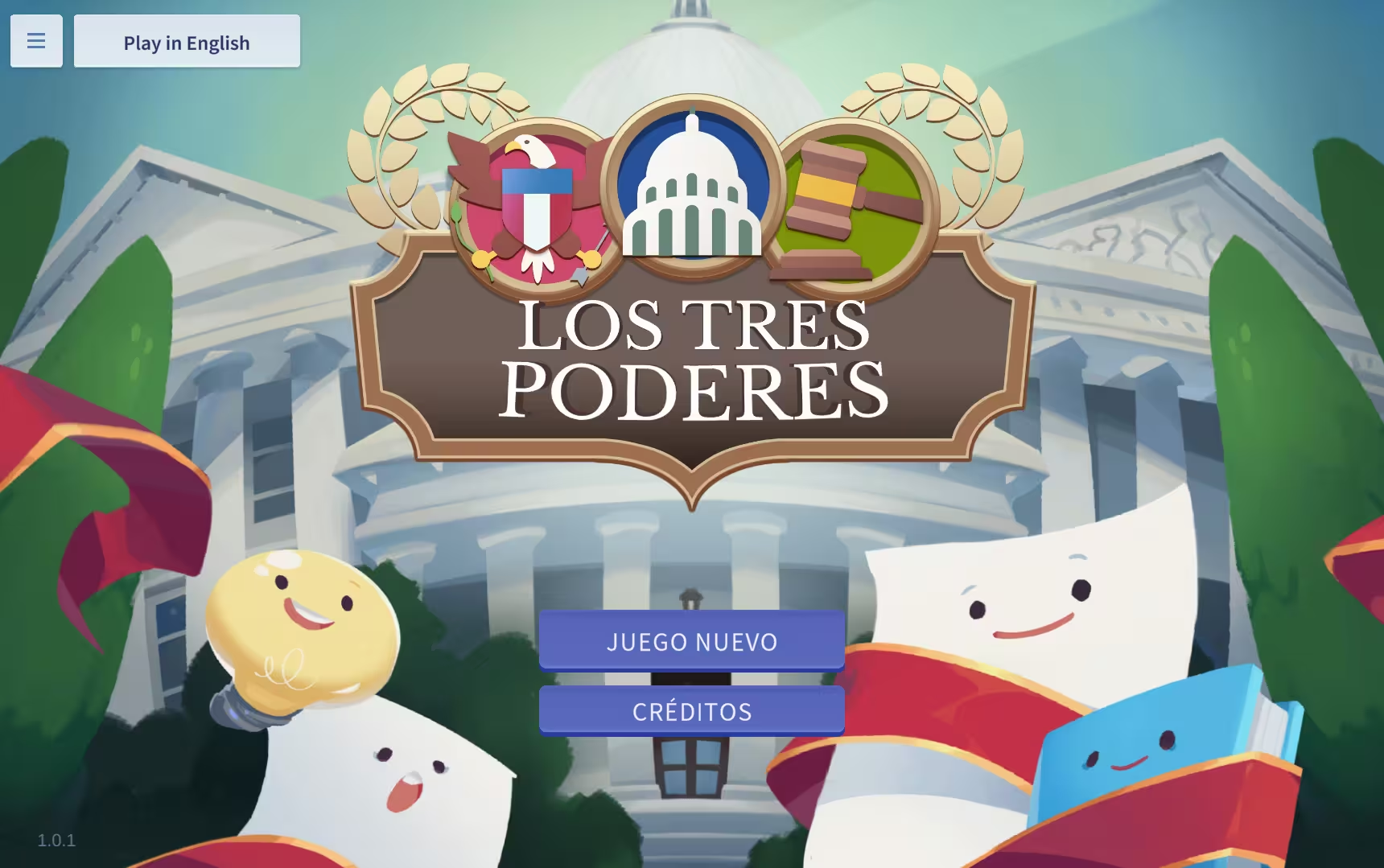
Branches of Power is a civics learning game developed with iCivics that allows players to take control of all three branches of the United States government. Players manage executive, legislative, and judicial responsibilities to understand how laws are created, applied, and reviewed within the federal system.
Explore →June kept talent development leaders busy as enterprise teams sought reliable ways to measure and sustain operational readiness. Throughout the month, our Content Hub investigations focused on the hard data driving modern workplace education. We examined how interactive sandboxes verify practical competencies, how extended reality de-risks high-stakes onboarding, and why dynamic scenario modeling outperforms static slide decks. Read on for a roundup of June’s discussions to see exactly how purposeful game design builds decisive, high-performing employees.
Our workforce readiness coverage kicked off by evaluating how regional talent pipelines track discrete, demonstrable capabilities. The National Association of Workforce Boards published its Skills Economy Toolkit in 2026, highlighting Deloitte data which confirms that skills-first organizations are 107% more likely to place talent effectively and 98% more likely to retain top performers. Traditional resumes struggle to verify practical expertise, leaving talent teams with blind spots during onboarding. Researchers found that custom learning games solve this measurement challenge by providing interactive sandboxes where employees actively demonstrate operational reflexes. These digital environments allow hiring managers and corporate leaders to capture portable, verifiable competency data that directly eliminates labor market friction and accelerates time-to-productivity across teams.
We continued our skills tracking analysis by examining how interactive artifacts validate professional development. Endless Access and the Arizona State University Endless Games and Learning Lab released a March 2026 report explaining how collaborative gameplay mechanics mirror modern workplace demands. Their findings indicate that nearly 44% of workers require reskilling by 2030, driving major enterprises to prioritize demonstrated abilities over static university degrees. Digital Promise published supporting research in May 2026 positioning microcredentials as the fundamental currency of career advancement. Enterprise training developers use short, targeted game modules to issue verifiable digital badges. These playable portfolios give corporate talent leaders immediate trust in employee proficiency while delivering precise performance analytics that traditional compliance tests miss.
Mid-month investigations turned toward zero-error corporate environments where traditional onboarding feels insufficient. A randomized controlled trial published in JMIR Medical Education evaluated virtual reality onboarding against physical simulations for novice practitioners managing acute emergencies. Researchers tracked 164 interns and observed that procedural confidence jumped significantly from 3.78 to 6.20 out of 10 following VR sessions. Participants praised the virtual platform for removing external distractions and facilitating focused, stepwise problem-solving under pressure. Frontiers in Virtual Reality published an editorial confirming that extended reality simulations cultivate vital psychological resilience and attentional control. Immersive first-person environments allow frontline employees to master high-risk protocol sequencing safely, delivering sensory fidelity that standard manuals can't match.
Our workplace gamification coverage moved beyond basic badges to evaluate consequence-driven decision modeling. Training Industry published a recent report detailing how generative simulation tools make branching scenario practice accessible across organizations. One highlighted enterprise achieved a 21% increase in skill performance alongside a 97% reduction in operational errors using adaptive practice platforms. McKinsey & Company released supporting analysis on digital-twin technology, explaining how virtual replicas of physical systems test live scenarios safely. Supply chain leaders deploy these virtual replicas to increase decision speeds by up to 90%. Embedding realistic operational friction into custom learning games ensures your frontline managers test hypotheses and build reliable leadership instincts before facing live corporate crises.
We concluded our June investigations by examining how simulated sandboxes solve the corporate forgetting curve. An August 2025 empirical study in Applied Sciences tracked 120 professionals across 25 enterprises practicing high-pressure client negotiations against dynamically adaptive virtual avatars. Trainees utilizing the simulation platform achieved an exceptional 89% knowledge retention rate four weeks post-intervention, easily outperforming classroom workshop participants who retained just 72% of their skills. Higher Education, Skills and Work-based Learning published a May 2026 trial confirming that scenario-based practice preserves vital crisis management abilities over extended three-month evaluations. Aligning game mechanics directly with explicit operational objectives anchors complex behavioral habits, ensuring your workforce doesn't discard mandatory compliance rules shortly after onboarding ends.
~
These enterprise findings confirm that replacing passive instructional content with consequence-rich digital play is essential for building a resilient, verifiable talent pipeline. We've spent more than 20 years perfecting the custom game mechanics required to turn strategic corporate training goals into permanent behavioral reflexes. Interested in bringing a custom, skills-aligned game learning solution to your corporate training portfolio? Let's talk.
Best practices for preventing motion sickness while maximizing learning outcomes.
Best practices for preventing motion sickness while maximizing learning outcomes.
Get the latest Game-Based Learning Review content delivered to your inbox, including new articles, videos, and industry insights.