

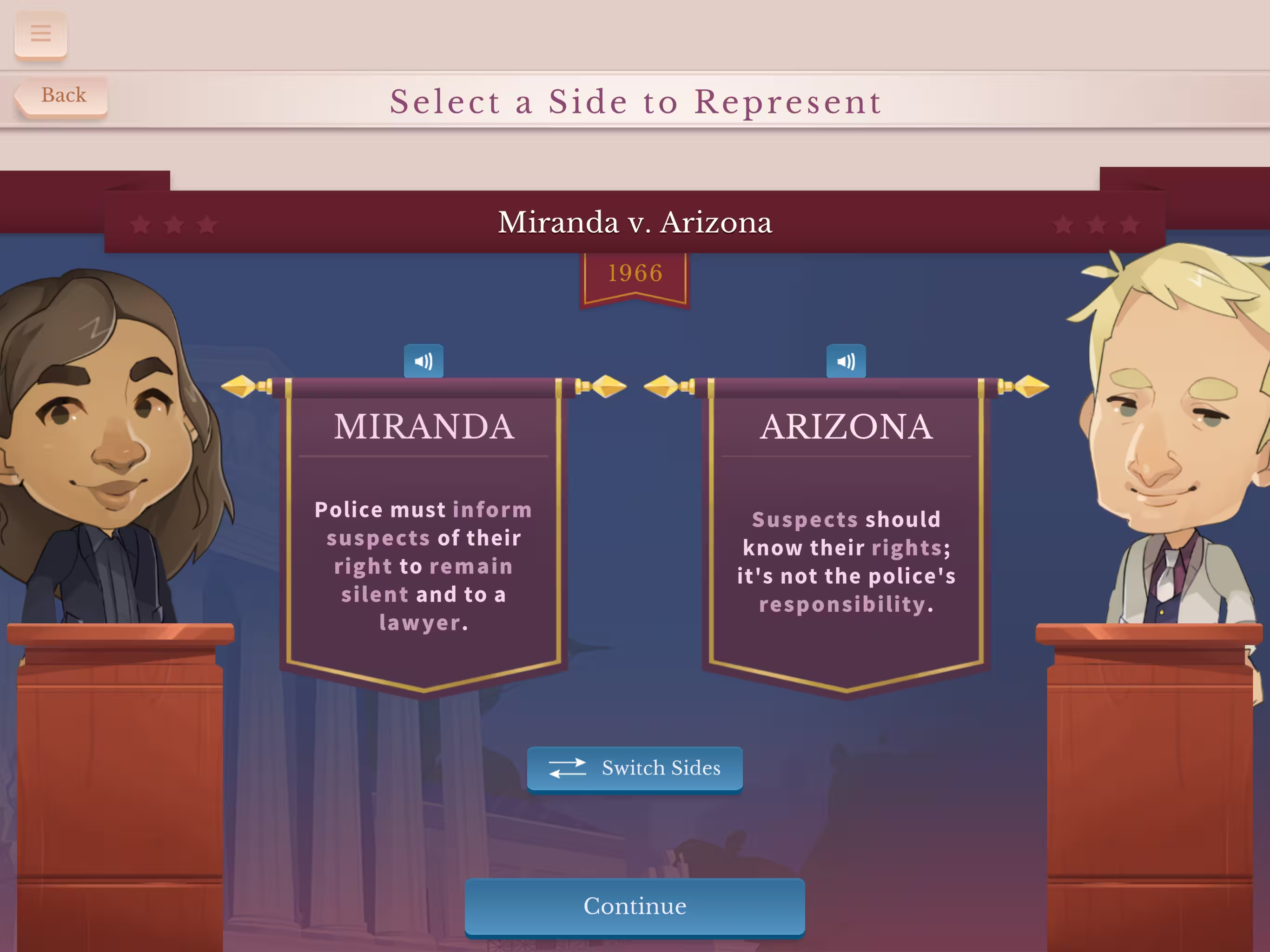
Argument Wars is a civics learning game developed with iCivics that puts learners in the role of an attorney arguing real Supreme Court cases. Using card-based mechanics, players face off against rival lawyers in landmark decisions to build persuasive skills and learn constitutional law.
Explore →
That’s Your Right! is a browser-based digital card game developed for the Annenberg Institute for Civics that teaches the first ten amendments to the United States Constitution. Playable in single-player and multiplayer modes, the game challenges players’ knowledge of the Bill of Rights through card-based gameplay.
Explore →This month brought a mix of new tools, research, and notable projects that are worth a look. The NYT’s major review of language learning apps breaks down how platforms are refining short, interactive lessons with built-in feedback. A new narrative game designed with Ojibwe communities is pushing language learning into homes and families and preserving cultural legacy. In professional training, accounting programs are leaning further into simulation-based ethics work, where learners have to make decisions with incomplete information. On the research side, a long-running study adds more evidence that certain types of cognitive training can have measurable effects decades later. There’s also a growing interest in having learners design games themselves, especially to understand complex systems. Behold:
A recent Wirecutter review of leading language learning apps outlines how tools like Babbel, Speak, Duolingo, and Pimsleur are refining their approaches to support different learning styles. These platforms focus on short, interactive lessons that combine vocabulary, grammar, and pronunciation practice, often supported by AI-driven transcription and conversational chat features. Babbel integrates grammar guides and situational dialogue, while Speak uses instructor-led video lessons paired with real-time speaking feedback. Across all four apps, the emphasis is on helping learners reach basic conversational ability quickly, with structured progression and clear feedback loops. The findings also reinforce a consistent limitation: these tools are most effective for foundational skills, after which learners must transition to real-world practice to continue advancing.
An MPR News feature highlights the release of Reclaim! Azhe-giiwewining, a point-and-click adventure game designed to support Ojibwe language revitalization. Players follow a young protagonist through a story-driven environment where interactions with characters and objects introduce vocabulary and cultural concepts. The game was developed through intergenerational workshops and includes voice acting in Ojibwe, allowing players to engage with the language in context. Designers focused on making the experience accessible across ages and playable within families, supporting language use outside classroom settings. By embedding language within story, relationships, and exploration, the game creates opportunities for repeated exposure in informal environments where fluency can develop over time.
This Journal of Accountancy article examines how game-based experiential learning is being used to train accounting students and professionals in ethical decision-making. These tools place learners in simulated scenarios where they must interpret incomplete information, evaluate competing priorities, and make judgment calls that carry consequences. Programs such as Red Flag Mania and Fraud Squad use branching narratives, multimedia evidence, and role-based interaction to replicate the ambiguity of real-world cases. The authors note that learners retain knowledge more effectively when they engage with these scenarios directly, and they report greater confidence in applying ethical principles in practice. This approach is also proving effective for first-generation college students, who benefit from applied contexts that connect theory to lived experience.
New findings from the ACTIVE study, covered by the Fisher Center for Alzheimer’s Research Foundation, provide longitudinal evidence on the effects of cognitive training games. Participants who completed a five- to six-week program focused on processing speed, along with follow-up sessions, were 25 percent less likely to develop Alzheimer’s disease or related dementias over a 20-year period. The study tracked more than 2,800 older adults and found that targeted, adaptive challenges produced lasting improvements in cognitive function. The training tasks required participants to make rapid decisions based on visual input, with difficulty scaling to match performance. These results suggest that relatively short, structured interventions can influence long-term brain health, especially when designed to challenge specific cognitive processes.
A feature from Times Higher Education explores how game-making workshops are being used to teach complex systems such as climate dynamics. In these sessions, participants design their own board games using simple materials, translating real-world challenges into rules, mechanics, and player interactions. The process requires teams to identify key variables, define relationships, and iterate on prototypes through testing and feedback. Educators report that designing a game strengthens systems thinking by making assumptions visible and forcing participants to consider multiple perspectives. The workshop structure emphasizes rapid prototyping, collaborative problem-solving, and reflection, turning abstract concepts into playable models that evolve through interaction.
–
That wraps up this month’s developments! Whether through conversation practice, cultural storytelling, ethical simulation, cognitive training, or systems design, educational games are continuing to create environments where learners act, decide, and reflect. If you’re looking to build experiences that carry this kind of impact into your own portfolio, let’s talk.
Best practices for preventing motion sickness while maximizing learning outcomes.
Best practices for preventing motion sickness while maximizing learning outcomes.
Get the latest Game-Based Learning Review content delivered to your inbox, including new articles, videos, and industry insights.