

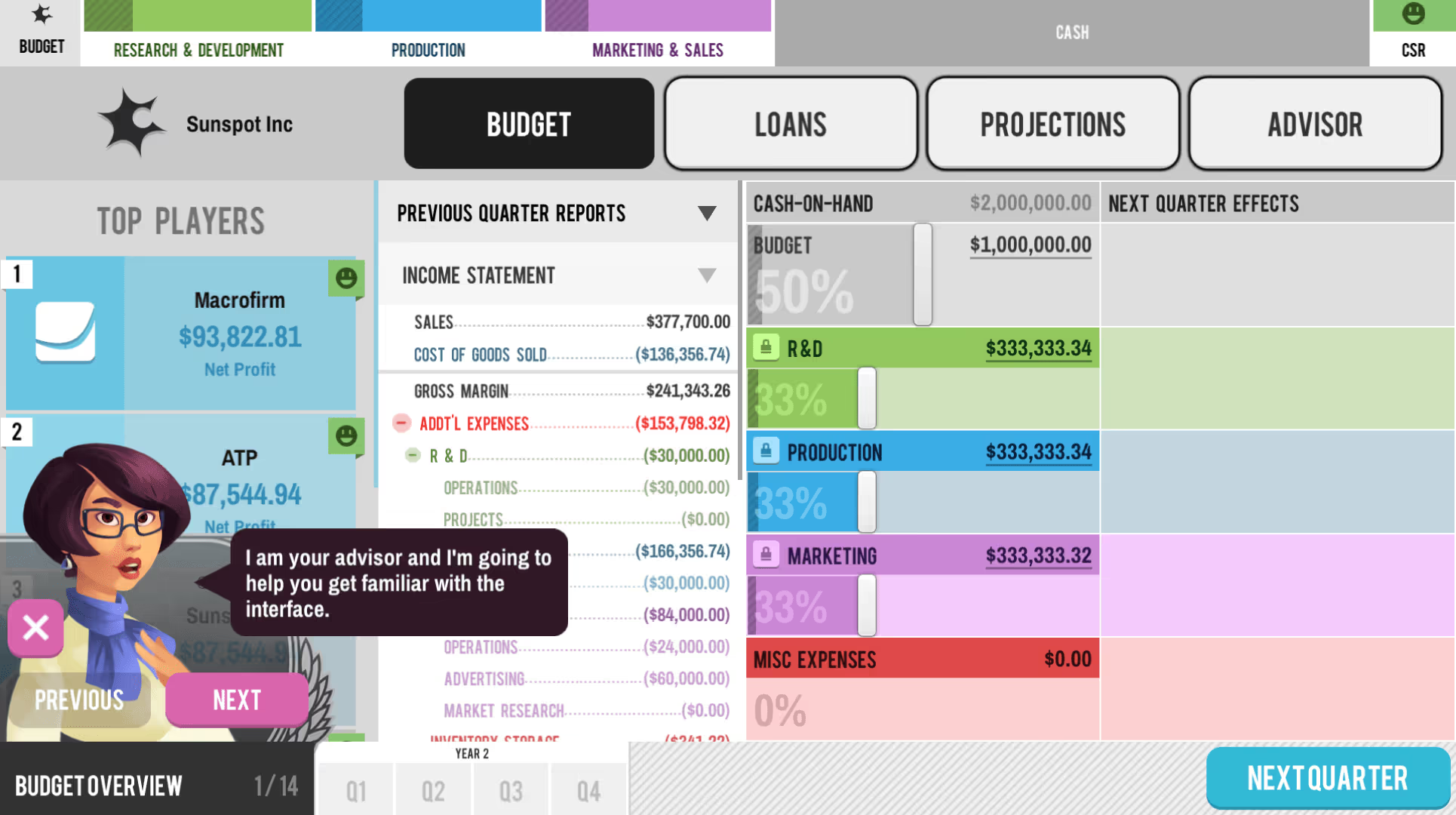
JA Titan is a financial literacy and business administration learning game developed with Junior Achievement that focuses on corporate decision making in a competitive market. Players take on the role of a company executive, making quarterly decisions about budgeting, production, and stakeholder priorities to improve business performance.
Explore →
Across Karman is an interactive web experience developed with the Wilson Center that focuses on space systems and global collaboration. Users explore an orbit-based interface to understand how satellites and space infrastructure support everyday life.
Explore →🎉Happy New Year!🎉 We’re starting off this year on the blog with some fresh game-based learning news! From the futuristic Metaverse to a retrospective on a trailblazing edugame from the 70s, this nifty roundup of serious games news abounds with fascinating tidbits for all. Keeping gaming enthusiasts well-fed with educational gaming news since 2019, this is What’s New in Game-based Learning!
via Giphy
The future is upon us! STEMuli, an educational metaverse company, is a finalist for a 1 million dollar prize for its implementation of a virtual schooling system at Dallas Hybrid Preparatory. Dallas Hybrid Prep is the first permanently hybrid school in the Dallas Independent School District. The school’s partnership with STEMuli aligns with the school’s vision to, according to principal Dr. Olga Romero, “‘… spark curiosity and to engage in ‘Always learning, loving how to learn.’” On certain days of the week, students attend school virtually with self-created avatars, learn in virtual classrooms, and tread non-traditional school environments, such as castles!
Learn more about STEMuli in the video below:
Here at Filament, we’re big fans of games that teach literacy skills, whether it be financial, media, or the classic language arts variety! Falling into that last category is Read to Lead, an EdTech nonprofit focused on building literacy in middle school students. Read to Lead offers several simulation games in which students take on leadership roles in a variety of workplaces and make decisions that affect people and institutions around them. Through these educational games, students gain literacy and social-emotional learning skills to prepare them for their futures! Recently, Read to Lead was awarded by AT&T’s Aspire Accelerator program, through their competition called “Pitches with Purpose.” Find out more about Read to Lead in the video below.
We’ve previously covered student-created games that make an impact – here’s even more! Game Design students at Griffith University in Queensland, Australia, have been rolling out a series of games called “games for purpose.” Among them is Hearoes, a game “which assists cochlear implant and hearing aid recipients learn new sounds in an engaging, self-paced environment” designed by Griffith graduate Elliot Miller. The lineup also includes a game on endangered music created by student Tenika Altena, and a game designed to teach children about water security created by student Ainsley Brooks-Webb. With their games, the students hope to assist with current research at the university, as well as raise levels of awareness and advocacy for the games’ respective subjects.
Screenshot of Hearoes gameplay, via Griffith University
If you didn’t know already, The Oregon Trail is a pivotal part of educational game history, and the game recently reached its 50th anniversary! This feature by friend of Filament Greg Toppo interviews the game’s original creators, Don Rawitsch, Bill Heinemann, and Paul Dillenberger. The article covers the story of the game’s creation, its first test in schools and its reception by students (spoiler alert, they loved it!), and the current iteration of The Oregon Trail, which is now a mobile game created by Gameloft. Read about all of this and more, including how The Oregon Trail changed the way many teachers approach teaching history in their classrooms! If you’re still in the mood for a blast from the past after reading the article, check out Filament’s “Retro Review” of the game below:
Call our CEO, Dan White, cause he’s going to want to sign up for this class! (In case you’re unaware, he may have mentioned here and there that Civilization is his favorite game). History teacher Ryan Botting has attracted attention on TikTok for the way he teaches world history. Botting explains that while he also teaches a traditional course, he also offers a class that includes two video games as learning aids: turn-based strategy titles Civilization VI and Humankind. According to the PCGamesN article, Botting has shared that this unconventional class increases students’ motivation to learn. Botting shared his discovery that “The class generally attracts kids that hate school and are looking for an easy grade, but what I find is these kids work harder and care more than their traditional-learning counterparts.” Find out more about Botting’s class via his Tiktok, @justbotting, and in the video below!
Did we miss any educational gaming, games for impact, or AR/VR for learning news? Let us know on Twitter or Facebook!
More game-based learning news:
What’s New in Game-based Learning – December 2021
Best practices for preventing motion sickness while maximizing learning outcomes.
Best practices for preventing motion sickness while maximizing learning outcomes.
Get the latest Game-Based Learning Review content delivered to your inbox, including new articles, videos, and industry insights.